

A note from FFJ — Our collaborative ‘architecture of food’ issue has come to a close (see our editors’ letter below), and we will now be entering a quieter period: Zoë has been on parental leave since the start of the year, with Isabela now joining her for the remainder of 2026. You can still expect new content from us now and then, and if you miss us, we encourage you to check out our ten-issue archive! Thanks for your patience with our two-person team during this expansive time.
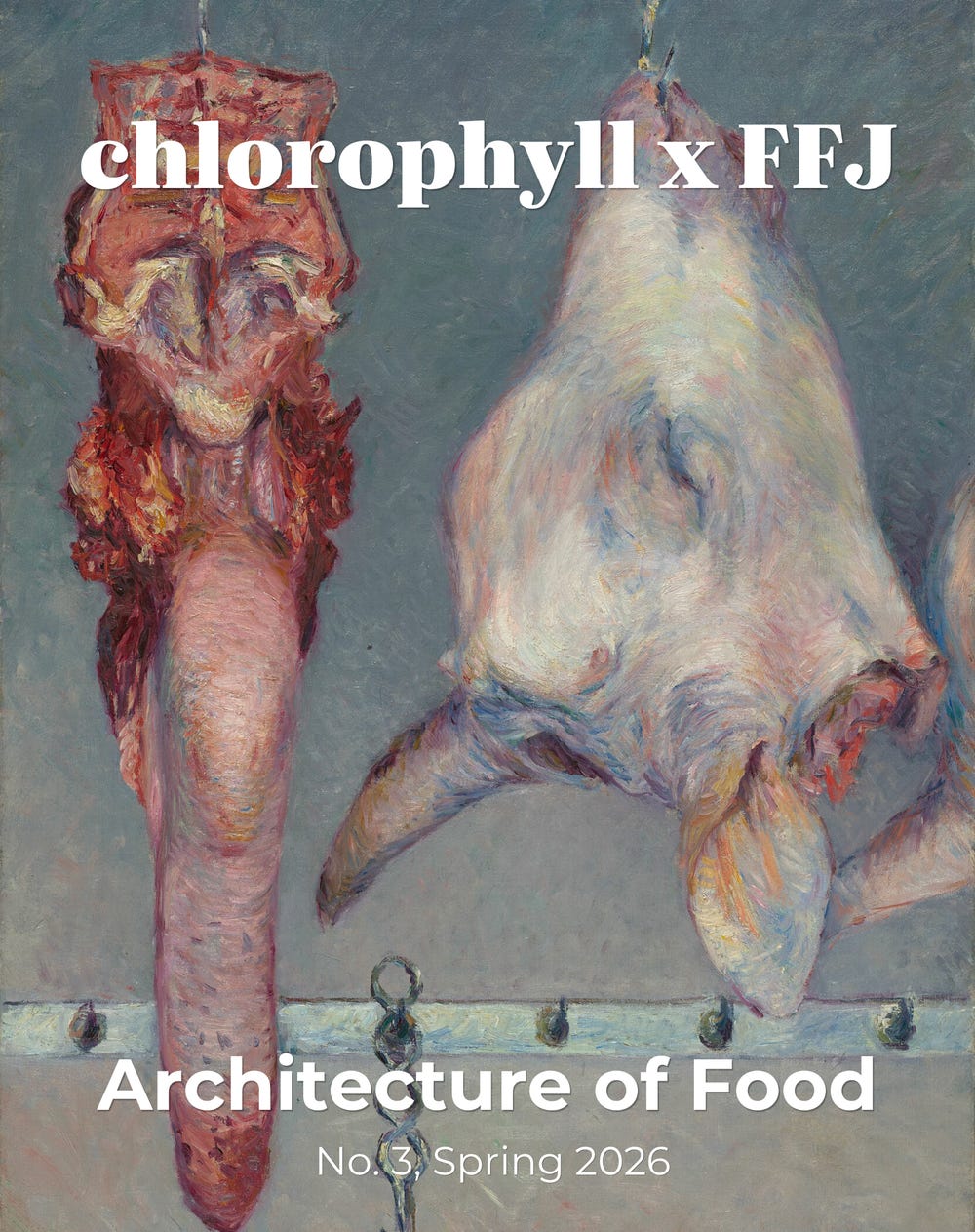
The concept of ‘the architecture of food’ first emerged during a brainstorming conversation between chlorophyll magazine editors Apoorva Sripathi and Anne Wallentine. Apoorva Sripathi had been inspired by the ephemerality of Irving Penn’s photos of frozen food, with the fragile sturdiness of ice locking the vegetables in place, symbolic of the cold chain that rules our modern food systems. She and Annie began to wonder what else might be unpacked within this tension between food and infrastructure.
From that conversation, a partnership between chlorophyll and FFJ emerged organically. FFJ’s relationship with Apoorva goes back to 2021 when she wrote for our inaugural issue, MILK, and we’ve since been lucky enough to have her guest edit and illustrate many of our essays. It was a dream to team up on this issue and to get to know Annie, in a trilateral partnership spanning Los Angeles to London to Barcelona.
So why the architecture of food? While food is often considered a great unifier, it has its divisions. We all have different ways of approaching food, from formal ordered courses to family-style meals, from the nuanced languages and hierarchies of menus to the ways cookbooks and recipes shape our lives, from home kitchens to restaurants and food systems that shape how we eat. The architecture of food is layered, complex, and delicious. In short, this issue was a no-brainer to produce collaboratively, spanning borders, cultures, experiences, and perspectives. We were proud to feature works from so many talented writers from around the globe:
THE ARCHITECTURE OF FOOD
NON-FICTION
Meat and Two Veg by Beth Whelan
Shellshocked by Genevieve Bentz
Priceless by Tien Nguyen
No Catch by Eileen McKay
The Making of Maamoul by Lina Saad
No English Menu, Please by Rebecca Thimmesch
Fold in the Cheese by Alexandra Badescu
Women at the Tables of Empire by Lea Horvat
Kitchens of Rice and Bread by Misha Paul
The Devil’s in the Dairy by Bryony Streets
Cuts and Foundations by Nandana Hareesh and Ritika Sharma
POETRY
On Your Heart by Hena Mustafa and Nasma Kublawi
Culture Club by Apoorva Sripathi
Self-preservation by Apoorva Sripathi
Sugarcube by Lari Burgos
FICTION
The Whistleblower
Meat and Two Veg by Beth Whelan examines the structure of the iconic British meal of meat and two veg during the industrial age and why this has since endured. Shellshocked by Genevieve Bentz looks at what we can learn from the incongruence of oysters, whose fragility bely their strength; Priceless by Tien Nguyen uncovers the history of on ladies’ menus that embedded historic gender norms around dining and finance; Lina Saad looks at pastry as an architecture of ritual and resistance in The Making of Maamoul; Rebecca Thimmesch unpacks the limitations and delights of menu translation in No English Menu, Please; Fold In the Cheese by Alexandra Badescu questions the assumptions baked into cooking instructions; Lea Horvat’s Women at the Tables of Empire highlights the brave women who carved out a place for themselves in public cafes in Belle Epoque of Habsburg South; in Kitchens of Rice and Bread, Misha Paul looks at the ways ingredients structure the rhythms and norms of a household; Bryony Streets considers the theological and commercial underpinnings of dairy as sin in The Devil’s in the Dairy; and Nandana Hareesh and Ritika Sharma use offal to illuminate the architecture of caste in Cuts and Foundations.
We’ve also had equally stellar fiction and poetry — The Whistleblower, a short story on architecture as circles of violence with hints of magical realism by FFF member Margaux Vialleron; Self-preservation and Culture Club, poetry on yogurt cultures, structures, and their resilient networks by chlorophyll’s own Apoorva Sripathi; On Your Heart, a poem on the ritual, sacrifice, and performance of domestic labour by Hena Mustafa and Nasma Kublawi; and Sugarcube, a meditation on fractal, eroding homes by Lari Burgos.
In short, this issue has been a delightful confluence of the material and invisible ways that the world is built. We hope you’ve had an equally wonderful time reading the issue as we’ve had in producing it. If you enjoyed the issue, please do consider supporting our publications; support from our paid subscribers is what allows us to keep doing this work and paying writers as well as we can.
Warmly,
Isabela, Apoorva, and Annie