

How do ingredients shape the rhythms and dynamics of a household? In this essay for our collaborative ‘architecture of food’ issue with chlorophyll magazine, Misha Paul explores the differences she’s experienced between growing up in a Bengali home where rice structured every meal, and navigating a German kitchen built around bread, precision, and quiet efficiency.
By Misha Paul
In the home I grew up in, and the houses I frequented, every meal began with rice.
More often than not, I woke to the sound of a pressure cooker whistling nonchalantly, its drone punctuated by the smell of freshly tempered spices. Even before I had brushed my teeth and found my bearings, I could see that vegetables had been cut, and fish had been marinated. At the centre of the scene was my mom, briskly moving between sections of the kitchen in a soft taant-er saree — a traditional, breathable handloom cotton saree from Bengal, woven for comfort in the humidity of daily life.
As soon as she spotted me, she’d let me know that my breakfast was already on the table. And I could only wonder: How long had she been in the kitchen?

My parents always made it clear that for me, as a daughter in a middle-class Bengali home, education was the top priority. My mother rarely allowed me inside the kitchen — because helping her out meant wasting precious hours that could be spent preparing for a competitive exam or mastering the arguments for some extempore my dad had signed me up for at school. Meal preparation — washing the rice in a steel bowl, swirling it through water until the cloudy starch ran clear, and the eventual process of cooking —was an integral part of my family’s routine. But to me, it was rendered invisible. So, until the day I turned 18 and left home for my further studies, I was unaware of the true labour involved in maintaining a kitchen.
It is only when you begin buying your own groceries, deciding every day what to cook, and making those choices within the constraints of a tight budget — a result of the abomination that is an early-career salary — that you begin to understand the sanctity of cooking work. Later, when I began cooking regularly — only three years ago, in my late thirties, after embarking on a “fitness journey”— I finally came to appreciate the mathematics, physics, chemistry, and, above all, the love behind meal prep.
Recently, I also started to see how the kitchen is shaped by the ingredients it houses. After hovering around my mom’s kitchen and tinkering in my own, at 39 years of age, I find myself spending time in a faraway kitchen shaped by an entirely different foundation — my mother-in-law’s.
My mother-in-law is German, and in her home, meals often centre around bread. Germany has a strong tradition of Abendbrot (literally “evening bread”), where dinner is often a bread-based meal with cheese, meats, pickles, and spreads. This, for me, was a new world of ingredients: these breads aren’t just the Britannia or Modern brands of bread that I, as an Indian, was used to eating. In entering her kitchen, suddenly I was being introduced to Bauernbrot (farmer’s bread), Roggenbrot (rye bread), Vollkornbrot (wholegrain bread), Brötchen (crusty bread rolls), Laugenbrötchen (pretzel bread rolls), Schwarzbrot (black bread), Mehrkornbrot (multigrain bread), and Zwiebelbrot (onion bread), among others. These breads are made with sunflower, flax, oats, and sesame — ingredients that are generally absent from the Bengali kitchen.
During Abendbrot, bread occupies the centre of the table, sliced into immaculate, uniform pieces using a Brotschneidemaschine (a bread slicer —popularly used in German households, bakeries, and grocery stores— that allows you to cut uniform slices of fresh, crusty bread using a mechanically rotating circular blade), accompanied by a vibrant side of cheeses, butter, cold cuts, pickles, or jam. Every diner wields a knife, a fork, and a small wooden board to use as a plate. The meal unfolds through small, deliberate choices rather than helping oneself to a single, central dish.
Like in my childhood home, my German in-laws also try to keep me away from the kitchen so I can focus on my “office work”. But my curiosity draws me to this quiet space, one devoid of the whistle of the pressure cooker or the crackly tempering of the bay leaf, and built instead around differently shaped knives, temperatures, sauces, and much cold meat. In these moments, I began to notice how differently food can organize the domestic world. In my mother’s kitchen, the meal is constructed through layers of labour that unfold across the day (and sometimes even the previous day). Moving between Indian and German kitchens, I began to understand food as a kind of architecture —not just something we eat, but a structure that shapes our habits and expectations.
MENU: Traditional Bengali dinner
Steamed Gobindobhog Rice (Steamed aromatic short-grain rice)
Masoor dal (Red Lentil Stew)
Labra (Slow-cooked mixed vegetables)
Rui Macher Jhol (Light river fish curry or Rohu fish in a light spiced broth)
Jhuri bhaja (Crispy shredded potato fry)
Bengali salad (kachumber style) (Fresh cucumber-onion-tomato salad)
Tomato Chaatni (Sweet tomato chutney)
Mishti (Bengali sweets or traditional Bengali dessert)
Papod (Crispy lentil wafer)
Total cooking time: ~1 hour 15 minutes | See full recipes at the end of this piece.
Note: The Bengali bhater thala (rice plate) is not a single dish but a composite meal, built from many small dishes that orbit a mound of rice. Traditionally, the meal begins with rice and bhaja, then dal, then vegetables, and finally fish curry. It ends with an assortment of sweets.
MENU: German Abendbrot
Bread: Different varieties of bread, either baked at home or picked up fresh from the local bakery, like Zwiebelbrot (onion bread), Roggenbrot (rye bread), Vollkornbrot (wholegrain bread), Brötchen (crusty bread rolls), Bauernbrot (farmer’s bread), and Laugenbrötchen (pretzel bread rolls).
Dairy: Butter and an assortment of cheeses, either cut fresh from a wedge or opened from a packet. From Gouda, Tilsiter, and Butterkäse to soft cheeses like Camembert or Brie, each is laid out for diners to choose from.
Meat: Cold cuts and cured meats, sliced fresh or served straight from their packaging: Leberwurst (liver sausage), smoked or cooked hams, Knackwurst (a smoked or lightly cured sausage), Blutwurst (blood sausage), Sülze (head cheese set in aspic, served plain or in jelly), and Mett (seasoned raw minced pork).
Spreads: An assortment of supermarket staples—mustard, herb cream cheese, quark, liver pâté, and other savoury spreads—alongside homemade preserves.
Fresh accompaniments: Thinly sliced cucumbers, tomatoes, radishes, Saure Gurken (pickled cucumbers), and occasionally lettuce or fresh herbs, allowing everyone to mix and match according to taste.
Total preparation time: Around 5 minutes.
Note: Most of the work lies not in cooking but in assembling. Bread is sliced, cheeses and meats are arranged, vegetables are cut, and homemade jams—often apricot or blueberry—have already been prepared, bottled, and stored. The rest is left to the diner, who composes their own meal from the spread before them.
In a Bengali kitchen, rice demands time. It asks for someone to be present in the kitchen, to check the flame, to listen for the lid rattling slightly as the water boils. It cannot be hurried. It teaches a kind of quiet patience, and perhaps a certain intimacy with the domestic space. The kitchen remains active; someone, usually a woman, is present within it. The meal carries the memory of that labour. Rice creates a meal that assumes presence and continuity. Someone cooks, someone serves, and everyone gathers around a shared base.
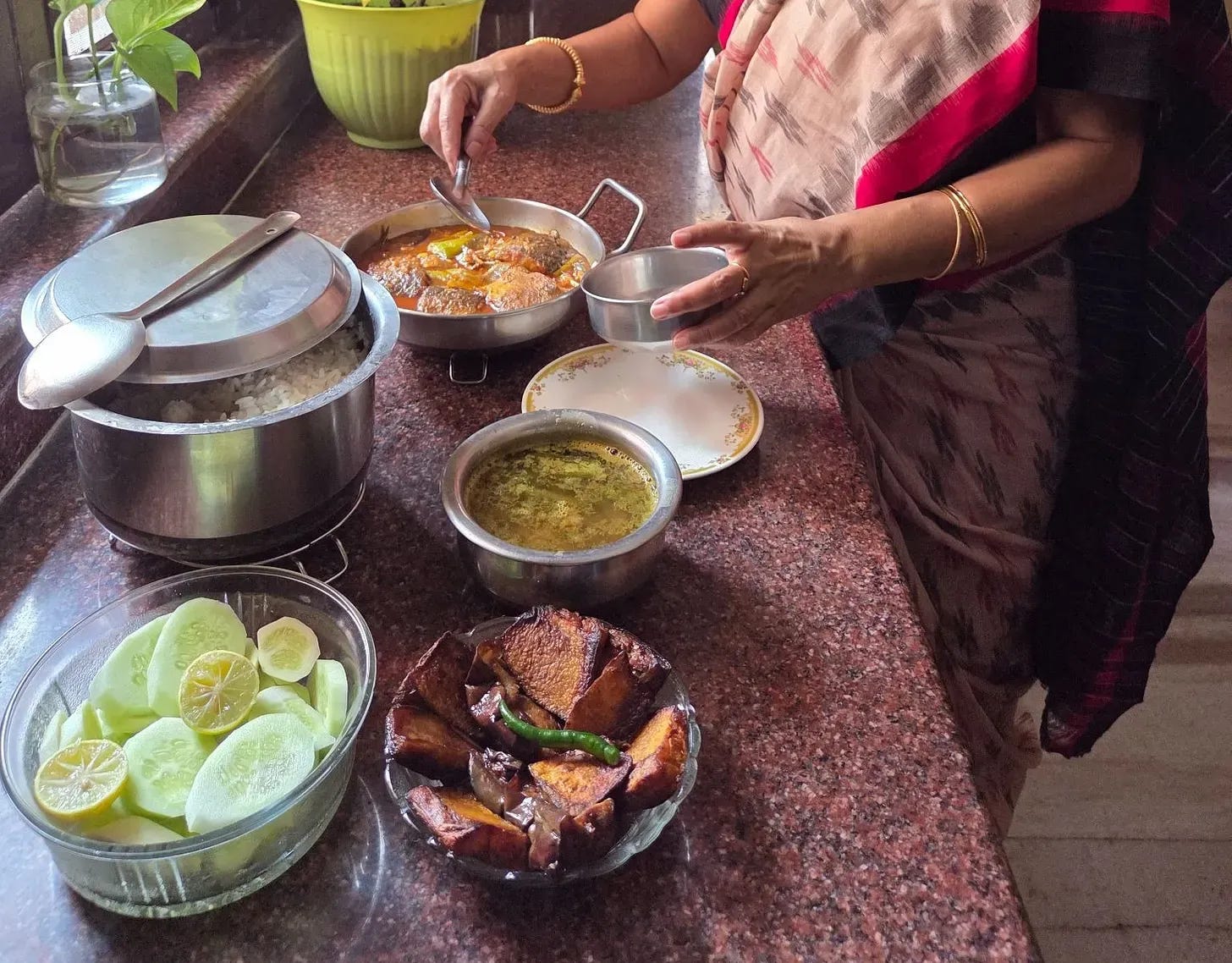
In my German husband’s family home, however, bread distributes that domestic structure differently. The bread has been either pre-baked or purchased from a bakery, so the work of the meal has often already been done before anyone sits down to eat; it’s up to the eater to assemble their plate with permutations and combinations of their choice. The meal becomes modular, assembled piece by piece by the eater. While rice-based kitchens depend on someone tending the cooking process from beginning to end, bread-centred tables allow greater flexibility, making the act of assembling a meal a shared responsibility.
Ingredients also shape individual eating habits. Rice encourages generosity. It is cooked in quantities that assume someone might want more. Meanwhile, bread encourages portioning; with careful slicing, everyone ensures the loaf lasts through the meal.
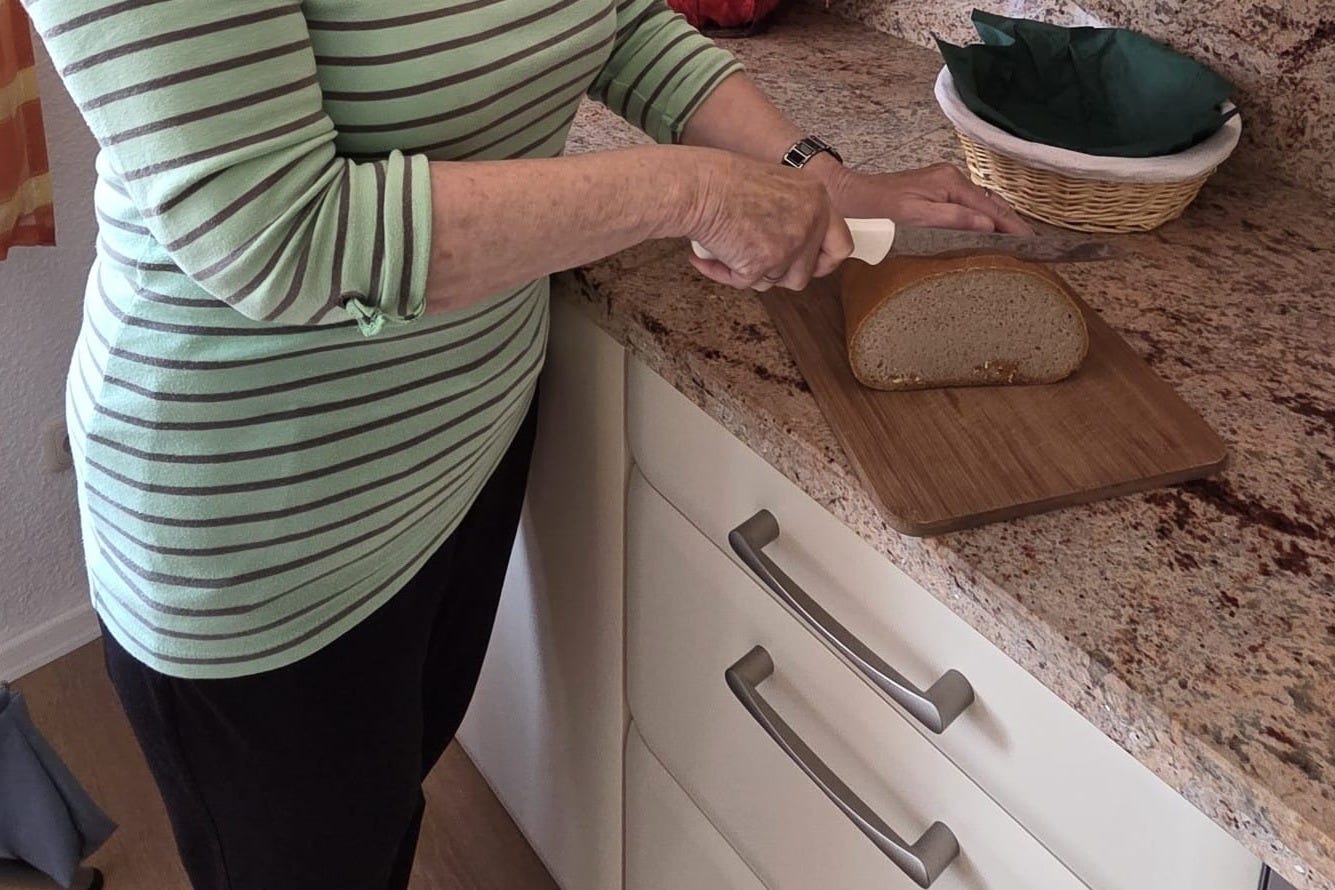
Even the gestures of eating shift. In many Bengali homes, rice is mixed and gathered with the hand or spoon, soft and adaptable. Bread requires cutting, spreading, and layering. The body learns these movements almost without thinking.
Neither system feels lacking. They simply organize time and space in different ways. Whether it is an elaborate Bengali meal that unfolds over hours, or a quieter German spread of bread, soup, and accompaniments, these acts shape the dynamics of a household — particularly when it comes to gendered labour. In my experience, it’s predominantly women who influence what ends up on the table. However, the demands and expectations placed on them between the kitchens are different.
In Bengali cuisine, the smells, the sounds, the shopping, the stocking, seem to happen so seamlessly that a woman’s presence begins to dissolve into the background, taken for granted even as it sustains everything. The elaborate meal unfolds course after course like a magician’s trick. Steamed Gobindobhog rice, masoor dal, labra, jhuri bhaja, fish curry, chutney, salad, mishti — each element appears at the right moment, hot/ cold and replenished before anyone notices its absence. But unlike magic, the labour is real, repetitive, and expected. There is rarely curiosity about what happened behind the scenes, only opinions about the final performance: the salt is too little, something is fried too much, the lentils are watery, the rice a little too soft. The meal invites commentary because it carries the visible weight of error.
Bread and cold cuts operate differently. An Abendbrot table asks less of the stove and less of the woman standing beside it. The labour is quieter, shifted toward sourcing, slicing, arranging, and preserving. Yet that subtlety also changes the expectations placed on the host. While the Bengali system expects the woman to constantly produce warmth, the German one allows her, at least occasionally, to step away from the fire and sit at the table sooner, to eat zussamen (together).
The kitchen is not the first place where I have lived between systems. I am a probashi Bengali, aka a Bengali who grew up outside of the native land of Kolkata. I grew up in the Hindi-speaking city of Bhopal, studied in an English-medium convent school, moved to Marathi-speaking Pune, and eventually worked in the sleepless city of Mumbai, speaking mainly the language of “time” and “deadlines”. Each place added its own tempering of spice, rhythm, and habit to my life.
Now, as I step into a German household, learning to navigate yet another new environment, my understanding of belonging and of a woman’s strong yet often invisible role feels ready for another quiet shift. I can sit at a table where multiple systems coexist, acknowledging the loving hands that are often taken for granted, and making space for both rice and bread. To belong is to learn to recognize yourself in both, even if completely in neither.
And perhaps that belonging also comes with a deeper responsibility: to appreciate the labour of the women who hold these worlds together. The women behind the steam of the rice pot and the careful slicing of bread, behind the stocked pantry shelves and replenished plates, behind meals that appear so effortlessly they are mistaken for inevitability. To see them as the quiet architects of a happy household. And to make sure they know — perhaps more often than we currently convey — that they are seen, valued, and above all, deeply loved.
Misha Paul is a reader, writer and marketing communications consultant based in India. She documents slow travels, lived cultures, and grassroots stories across India and beyond, focusing on sustainability, local communities, and meaningful storytelling that gives back. Find her on Substack or Instagram.
End note: Recipes for a feast
If you’re interested in recreating the sample Bengali menu given above — or a refreshing German gurkensalat — here are the recipes.
Saure Gurken
A cooling, fresh contrast to heavier foods, usually served alongside meat dishes, with potatoes, and as part of summer meals. Unlike a Bengali meal that unfolds through layered cooking and heat, Gurkensalat is quick, cool, and assembled almost quietly, and requires very little active labour.
Ingredients
Around 1 kg of smaller cucumbers
1 litre of water
3 tablespoons of salt
6 tablespoons of sugar
13 spoons of vinegar
Dill, onions, whole yellow mustard seeds, whole black pepper, bay leaf, all as per taste
1 mason jar with rubber seal lid and wide opening that can hold all the cucumbers and the liquid.
Steps
Mix water and vinegar, add sugar and salt and bring to boil. Let it cool down a little bit afterwards.
Put cucumbers and spices into the jar.
Fill the jar with the liquid until the whole jar is filled. Seal the jar.
Let it rest for a minimum about 1 to 2 weeks in a dark and cool place.
Total preparation time: 10–15 minutes
Steamed Gobindobhog Rice
Total time required: 20 minutes
Ingredients
1 cup Gobindobhog rice
2 cups water
Pinch salt (optional)
Steps
Wash rice 3–4 times until the water runs mostly clear.
Soak for 10 minutes.
In a pot, add rice + water. Cook covered on medium flame for 10–12 minutes.
Once water evaporates, turn the flame low and steam for 5 minutes.
Fluff gently.
Start this dish while rice cooks. Total time: 20–25 minutes
Masoor Dal
Ingredients for dal
½ cup masoor dal
2 cups water
½ tsp turmeric
Salt to taste
Ingredients for tempering
1 tbsp mustard oil or ghee
1 bay leaf
1 dried red chilli
½ tsp cumin seeds
2–3 garlic cloves (lightly crushed, optional but traditional)
Steps
Wash masoor dal 2–3 times until the water runs clear.
Add dal to a pot with water, turmeric, and salt.
Boil on medium heat for 12–15 minutes until soft and slightly creamy.
Stir occasionally and mash lightly with a spoon for texture.
Tempering
Heat mustard oil or ghee in a small pan.
Add bay leaf, cumin seeds, and dried red chilli.
Add crushed garlic and sauté until fragrant and lightly golden.
Pour the tempering over the cooked dal and mix gently.
Optional finish: a squeeze of lemon or a pinch of sugar.
Labra
Total time: 30 minutes
Vegetables (traditional mix)
1 cup pumpkin
1 potato
1 small eggplant
1 radish
1 cup cabbage
Cut all into medium chunks.
Other ingredients
2 tbsp mustard oil
1 tsp panch phoron
2 dried red chillies
½ tsp turmeric
1 tsp cumin powder
1 tsp ginger paste
Salt
1 tsp sugar
½ tsp garam masala
1 tsp ghee
Steps
Heat mustard oil.
Add panch phoron + red chillies.
Add ginger paste.
Add all vegetables.
Add turmeric, salt, and cumin powder.
Cook covered for 20 minutes, stirring occasionally.
Vegetables soften and begin to mash slightly.
Add sugar, garam masala and ghee.
Rui Macher Jhol
Total time: 25 minutes
Ingredients
4 pieces Rohu fish
3 tbsp mustard oil
1 potato (optional)
1 tomato
1 tsp turmeric
1 tsp cumin powder
1 tsp coriander powder
Salt
2 green chillies
Fresh coriander leaves
Preparation
Rub fish with salt + turmeric.
Let it sit for 10 minutes.
Cooking
Heat mustard oil until smoking slightly.
Lightly fry fish pieces until golden (2 minutes each side). Remove.
In the same oil add cubed potato. Fry lightly.
Add tomato and cook until soft.
Add turmeric, cumin powder, coriander powder.
Add 1.5 cups water.
Bring to boil.
Add fish pieces + green chillies.
Simmer 8 minutes.
Finish with coriander.
Jhuri Aloo Bhaja
This is the thin crispy potato served with dal.
Total time: 15 minutes
Ingredients
2 potatoes
Mustard oil
Salt
Pinch turmeric (optional)
Steps
Peel potatoes.
Cut into very thin matchsticks.
Wash and dry thoroughly.
Heat oil in a flat pan.
Fry on medium heat, stirring constantly.
Cook until golden and crisp.
Sprinkle salt.
Bengali Salad
Total time: 5 minutes
Ingredients
1 cucumber
1 onion
1 tomato
1 green chilli
Salt
Lemon
Steps
Slice cucumber and onion thin.
Add chopped tomato.
Add green chilli slices.
Sprinkle salt and squeeze lemon.
Serve fresh.
Tomato Chutney
Total time: ~15 minutes
Ingredients
3 ripe tomatoes (chopped)
2 tbsp mustard oil
½ tsp panch phoron
2 dried red chillies
3 tbsp sugar (adjust to taste)
½ tsp salt
¼ tsp turmeric
¼ tsp red chilli powder (optional)
2 tbsp raisins (kishmish)
1 tbsp dates (optional, chopped)
½ tsp roasted cumin powder
Steps
Heat mustard oil in a small pan.
Add panch phoron and dried red chillies. Let them crackle for about 20 seconds.
Add chopped tomatoes and cook on medium heat for 5–6 minutes until they soften.
Add turmeric, salt, sugar, raisins and chopped dates (optional)
Cook another 5 minutes, stirring occasionally. The chutney will become thick, glossy, and jam-like.
Add roasted cumin powder at the end.
I eat rice as a staple and am looking forward to trying your recipes to make my own feast!
What I found especially interesting is the idea that an ingredient can organize a household, not just a meal. Bread does this in a very different way when it becomes part of the daily rhythm rather than something served alongside a meal.
As a sourdough baker, I see this in a small way at home. A starter creates its own rhythm of feeding, fermenting, baking, cooling, slicing, and saving a piece for the next meal. The loaf may take hours to make, but once it is on the table, it can make the rest of the meal remarkably simple.
Bread carries more than food on the table. It carries time, habits, and sometimes a whole household routine.