

This week’s essay — part of our architecture of food issue published in collaboration with chlorophyll magazine — is a portrait of the ways that women can build worlds with their hands (and a bit of semolina).
By Lina Saad
The first architecture I ever understood wasn’t a building. It was a pastry.
Growing up in Beirut, I remember my grandmother making maamoul in quantities that felt industrial in scale, trays upon trays of them, stacked like edible bricks across my grandfather’s home. The air was thick with the scent of pistachios, rose water, and orange blossom, a perfume that seeped into the walls and into my memory. I was too young to grasp the full meaning of what I was witnessing, but those wooden moulds, carved with ridges, lattices, and tiny sunbursts, were my first lesson in how women build worlds with their hands.
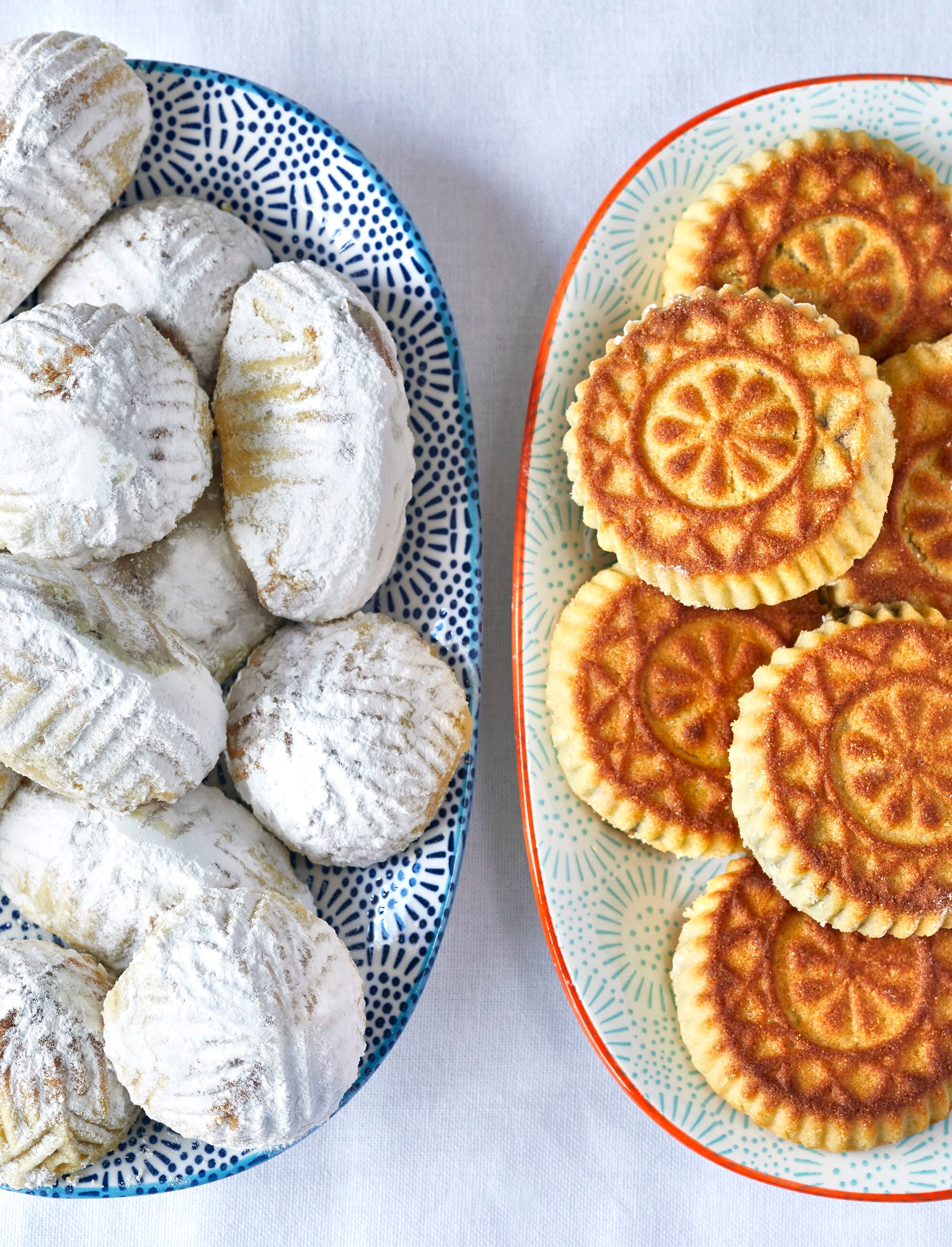
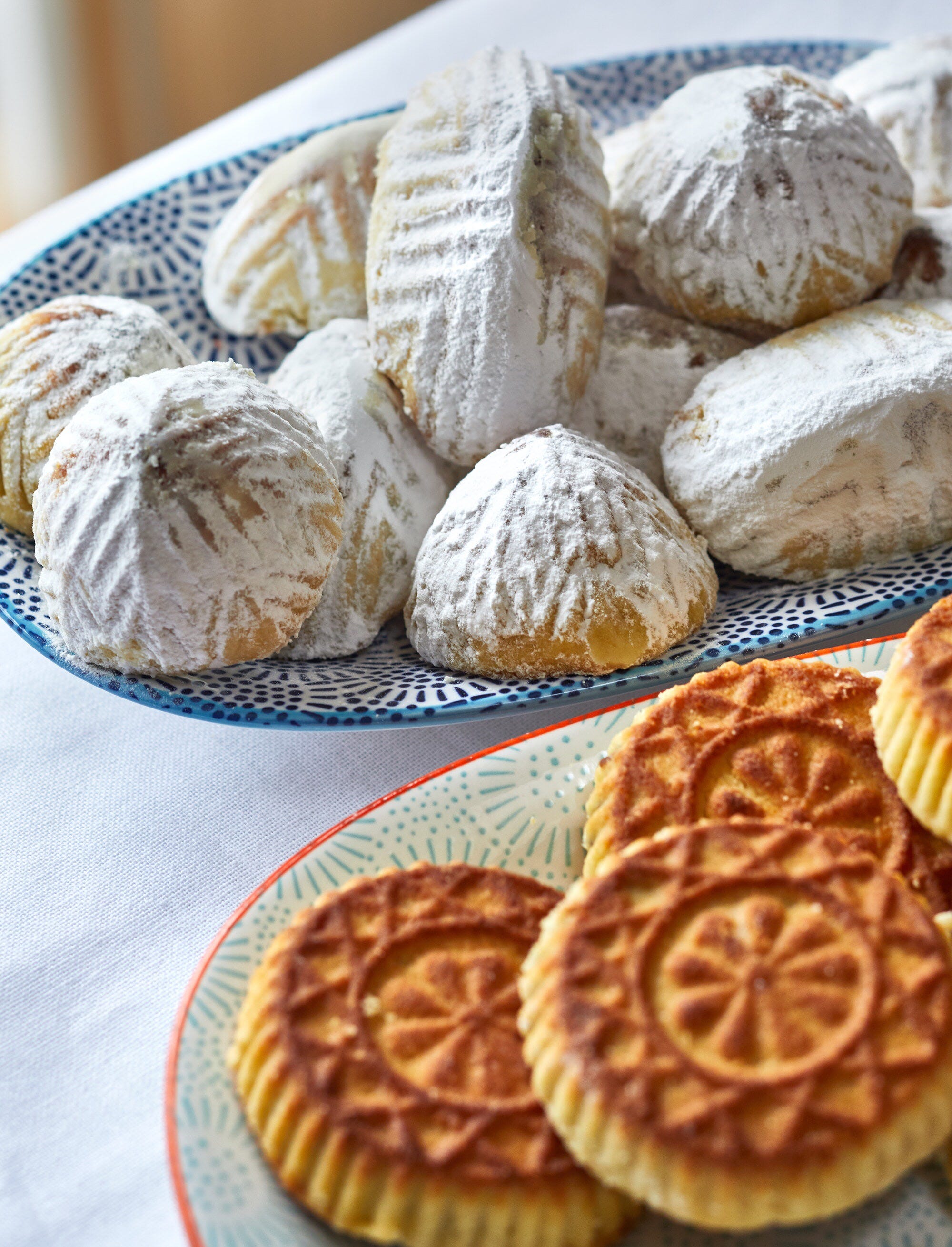
Maamoul has existed in the Levant for centuries, its origins stretching back to ancient Mesopotamia and the early Arab empires. Historically, it was a celebratory pastry, made for Eid, Easter, and other religious feasts. It was also a pastry made by women, who gathered in kitchens, courtyards, and balconies to shape hundreds by hand at a time. The work was repetitive, physical, and communal: mothers taught daughters, grandmothers taught granddaughters, neighbours taught neighbours. Even when war, migration, and displacement threaten the communities that make them, maamoul carry a lineage of ritual, relationships, and cultural continuity.

Maamoul structures time, marking the rhythm of the year. It appears every year at the end of Ramadan to signal a transition from fasting to feasting — from restraint to celebration. As a child, to me Eid morning meant waking to the sight of stainless-steel trays, each one holding dozens of pastries shaped, filled, and pinched shut by the women of my family. Their labour was quiet but immense, a choreography of kneading, filling, moulding, and baking that began days before the holiday.
When my mother moved to London, she carried those memories with her like a second spine. Her own mother had died while she was living in West Africa, building a business and raising a family far from home. Maamoul became her way of keeping that connection alive, a ritual that refused to let distance or loss erase the women who came before her.
In London, our kitchen became a reconstruction of Beirut, not in its layout or its appliances, but in its rituals. My mother’s maamoul-making was an act of rebuilding, a way of creating a familiar architecture in an unfamiliar city. She sat on the carpet because that’s how her mother had done it. She used the same wooden moulds she had brought from Lebanon. She insisted on resting the semolina overnight, even when time was tight, because some structures cannot be rushed.
I remember returning from university one year to find her sitting cross-legged on the carpet of our London kitchen, a large bowl of semolina in front of her. She was kneading it with rose water, orange blossom water, and ghee, her hands moving with muscle memory. She covered the dough and left it to rest for twenty-four hours.
“The longer it rests,” she told me, “the more rewarding the taste.”
It was a lesson in patience, but also in inheritance. Some things need time to become themselves.
Maamoul moulds encode a visual language that women have preserved for generations.
Maamoul come in different shapes, but these variations are not arbitrary; they are a form of code, telling you what to expect before you take a bite. A diamond shape signalled a luxurious filling of pistachios, often reserved for guests or special occasions. Domed, mountain-like maamoul held walnuts, a humbler choice. Flat, stamped discs were filled with dates, the most ancient of the three variations. As a child at my grandmother’s house, I learned to read these shapes long before I learned to read words.
Maamoul moulds are also carved with patterns that echo Levantine tile work and ancient motifs. Like my mother’s moulds from Lebanon, they are often passed down through generations, meaning their motifs can take on a particular familial resonance. For families and communities who have been scattered around the earth due to war and conflict, these traditions remind us of the homes and people we left behind. When I press dough into my mother’s moulds, I feel the importance of these legacies, and awed by how a simple pastry can carry history in its geometry.
In Lebanon, maamoul-making is rarely a solitary act. Women gather in groups — sisters, cousins and neighbours — to make hundreds at a time. The work is divided: one person kneads the dough; another prepares the fillings; another shapes the pastries, another bakes. Conversations flow as easily as the rose water. Stories are exchanged, advice is given, grief is shared, laughter fills the room. The labour is heavy, but it is held collectively.
This communal spirit is not incidental. In a region marked by political instability, economic hardship, and repeated cycles of displacement, communal food labour becomes a form of resilience. It is a way of reinforcing social bonds, preserving cultural knowledge, and asserting continuity in the face of rupture.
In the diaspora, this labour often shrinks to the scale of a single household. But when my mother and I make maamoul together in London, we try to ensure that the collective and communicative spirit remains. We recognize that we are supporting a structure that has held our family for decades.
Watching my mother work the dough, I see that diaspora is not just about loss, but also about construction. From fragments — a mould, a scent, a recipe, a memory — we are building new worlds, tethered to those of old. Maamoul is our way of saying: we are still here, and so are the women who shaped us.
These days, at Eid, when I take my first bite, I taste not just pistachios or dates or walnuts, but the entire world that made me.
Lina Saad is a London-based Lebanese food writer and award-winning author of three cookbooks whose work explores heritage, migration, and the cultural memory of food. Through recipes and storytelling, she preserves and celebrates Levantine culinary traditions, with a particular focus on women’s roles in sustaining family, identity, and community across generations. You can find her on Instagram as @alebanesechef.
Catch up with the previous pieces from the ‘architecture of food’ issue:
I’m incredibly grateful to Chlorophyll and Feminist Food Journal for publishing my article, “The Architecture of Maamoul.”
Thank you for giving space to this story, which explores the artistry, heritage, and cultural significance behind one of the Levant’s most treasured biscuits. It’s an honour to share a piece of my culinary heritage with your readers.
Thank you for your support and for championing thoughtful food writing. 🤍
Beautifully written!