

Quick announcement — we’re thrilled to share that tickets for the Oxford Real Farming Conference (ORFC) 2027 are now on sale! ORFC explores the questions at the forefront of the alternative food and farming movement; we’ve attended both online and in-person in past years and can only recommend it. The 2027 conference will run from January 7-8, and online tickets are particularly affordable.
Today’s essay by Nandana Hareesh and Ritika Sharma on meat and caste in New Delhi marks the conclusion of our ‘architecture of food’ issue, produced collaboratively with chlorophyll magazine. We hope you enjoyed this special edition!
In case you missed anything, you can catch up with all the previous pieces:
Meat and Two Veg
Shellshocked
Priceless
No Catch
On Your Heart
The Whistleblower
Culture Club
The Making of Maamoul
No English Menu, Please
Fold in the Cheese
Women at the Tables of Empire
Kitchens of Rice and Bread
The Devil’s in the Dairy
Self-preservation
Sugarcube
Cuts and Foundations
By Nandana Hareesh and Ritika Sharma
Imagine a city built entirely from meat. The towers rise from prime cuts — polished, boneless, and carefully curated. Their floors are sustained by fat rendered translucent. Residents ascend in elevators they don’t remember being built. The bridges fold from the brisket. Beneath the towers, a gizzard becomes a pillar. Intestines run as pipes and conduit. The structure is held, but the city above knows nothing of what holds it.
This city of meat already exists in New Delhi, India’s capital; its hierarchies of flesh are exposed in butcher shops. But before we examine the butcher shops, we must look at the city that surrounds them — and to understand the city, we must ask who built it, and whose bodies become its ground.
THE CITY
New Delhi is a city built on the aspirations of people who have migrated from different parts of the country, looking for a place to build their homes. Some may think that the city will never ask their surnames — allowing them to blend into a metropolis where one’s caste is no longer a feature that defines their lives.
Such was the hope of the revered anti-caste jurist and social reformer, Dr. Bhimrao Ambedkar, who in the mid-twentieth century imagined that rapidly growing Indian cities would become devoid of caste, and of the rigidity and the hierarchies that came with it. He called migration to cities a “new life movement”, believing that since the caste order was designed for a society agrarian in nature, it would lose its relevance in an urban setting.
But as much as cities did somewhat become spaces of upward mobility for Dalit and Bahujan communities through improved access to education and employment, their foundations remain unchanged. To this day, New Delhi’s structure — from its housing and havelis, to its roads and bastis, its labour force, the food served in air-conditioned rooms, and the meat markets — remains rooted in caste, religion, and class.
In the colonial period, architect Edwin Lutyens designed the city and built residential blocks that were segregated by race and rank; those in the highest position were supposed to be closest to the Viceroy’s house and those in the lowest position the furthest away from the colonial power. Despite New Delhi’s status as India’s largest metropolis, this logic of spatial segregation was never dismantled.1
Here the upper class, upper castes occupy the shinier pockets of the city. The shops in these neighbourhoods are often air-conditioned, built so that anything “impure” is kept away by design. But this is only a small part of Delhi.
The rest is where the soul of the city lives; to the people to whom it truly belongs, because they build and sustain it and have the greatest stake in it. Yet these communities are neglected, pushed into ghettos and congested resettlement colonies, where even the right to live with dignity is denied. The concept of basic access to roti, kapada, makaan (food, clothes and housing) does not even exist. The shops here are not enclosed or air-conditioned; they are open to the street. It is here that the labour behind the packaged, polished produce displayed in Delhi’s shinier pockets takes place.
The further the margins are pushed, the shinier the city’s centre is made to look.
THE MARKETS
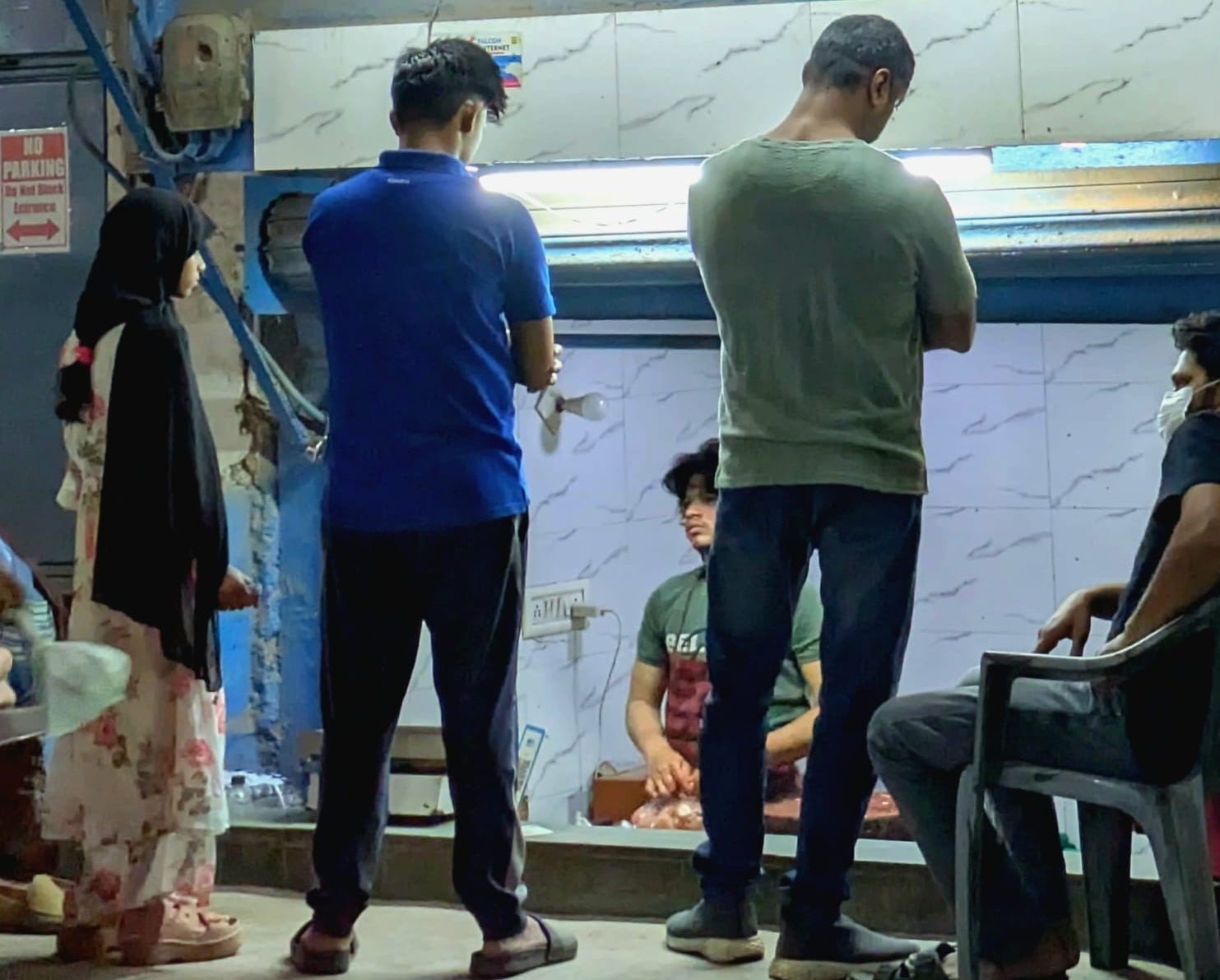
“Animals which were considered sacred and godly became unholy after their death.” (Patole, 2024)
In the more affluent enclaves of New Delhi, one can find ‘fresh meat shops’ selling pre-packaged meat. Similar products are sold at the butcher shops of New Delhi’s meat market — yet they occupy neglected areas of the city, and are pushed quite literally underground. Opening at dawn, long before the city awakens, the meat shops sit in half-basement structures, with only the upper half visible from the street. These are often congested spaces where butchering, cleaning, and cutting take place within close range.
Such isolation and neglect is rooted in the upper-caste objection to the presence of such markets. Vegetarianism in the subcontinent has never been simply a dietary preference. Brahminical vegetarianism constructed an elaborate hierarchy in which abstention from meat became the primary marker of ritual purity, while meat-eating — particularly of the sacred cow, or of parts of an animal considered waste — was used to define and enforce the boundaries of the “lower” social rungs. The question was not only which cuts of meat were cleaner but whether one ate meat at all — and the answer was used to exclude, humiliate, and contain entire communities from social life.
The same structural hierarchy applies to those involved in meat production and animal slaughter. As Dr. Ambedkar documented, occupational and dietary practices have long served as explicit pretexts for ritual exclusion. The labour of handling animals after death — the skinning, cleaning, and cutting — is assigned to the Muslim, Dalit, and Bahujan communities already designated as polluting. This logic is circular and deliberate: a low-caste community is assigned work involving death and waste, and this association is then used to justify their position at the bottom of the caste hierarchy. Their exclusion from society renders their labour invisible, making their original assignment to this work appear natural and inevitable.
At the eastern edge of Delhi, bordering the state of Uttar Pradesh, sits Ghazipur, the city’s lone abattoir. Before its construction, there was the Idgah abattoir, which had served as one of the oldest sources of meat supply for Delhi until a Supreme Court order in 2009 forced its relocation to the new mechanized Ghazipur facility. The move devastated the Idgah abattoir’s workforce, who were largely Qureshi (a Muslim community predominant in butcher work); only 25 to 30 of the previous 5,000 butchers were absorbed into the new slaughterhouse. One butcher told Caravan Magazine in 2019 that he now had no viable way to earn a livelihood: “Who employs a Muslim?”
Meanwhile, the new abattoir and murga mandi (meat market) sit less than four hundred metres from one of the city’s largest landfills. This location is unsurprising given the state’s treatment of the site: Since the government introduced the Citizenship Amendment Act (2019)2, Qureshi-run meat markets have been subject to recurring police crackdowns in protest of animal slaughter, and increased surveillance of licensing and environmental clearances. A single zone encompasses the meat that feeds the city, the waste the city produces, and the persecuted communities structurally assigned to handle both. This is the violence that precedes the meal.
THE MEAT
“The food culture of the upper castes and classes has been labelled and accepted as the food culture of the entire society, region and state. This has been done by scholars, researchers and experts in all eras. Naturally, the food culture of other marginalized social groups has been ignored or ridiculed. As a result, to outsider scholars, the food culture of that particular society or region appears homogeneous. The language of this elite class is also considered the standard language of the entire society.” (Patole, 2024)
When it comes to consumption, not all meat is considered equal. This mirrors the social hierarchies that govern both consumption and labour — who eats which part, who handles which part and whose relationship to the animal is one of complete use rather than curated choice. The hierarchy is not just contained between a ‘butcher shop’ and a ‘fresh meat shop’; it exists even within the different parts of meat sold in the butcher shop.
In the common butcher shops, the prime cuts (thighs, ribs, chest) occupy the counter, the most visible space, sanitized and packaged for markets catering to urban elite tastes. To buy them is to enter a social register of surplus and celebration, a marker of arrival in the city’s aspirational imagination.
The offal and skin are hidden backstage. In the butcher shop, the offal is accessed through a lowered voice, an exchange between people who share the knowledge of its availability without the shop having to advertise it on the counter. Dalit and Bahujan communities have long been systematically forced to consume gizzard, intestines, and skin as a condition of their structural position — these are the cuts left after everything else has been distributed, used by people for whom wasting food is not an option. The designation of certain foods as polluting by the upper caste is therefore not a neutral act of taste. It is a political act dressed in the language of the stomach.
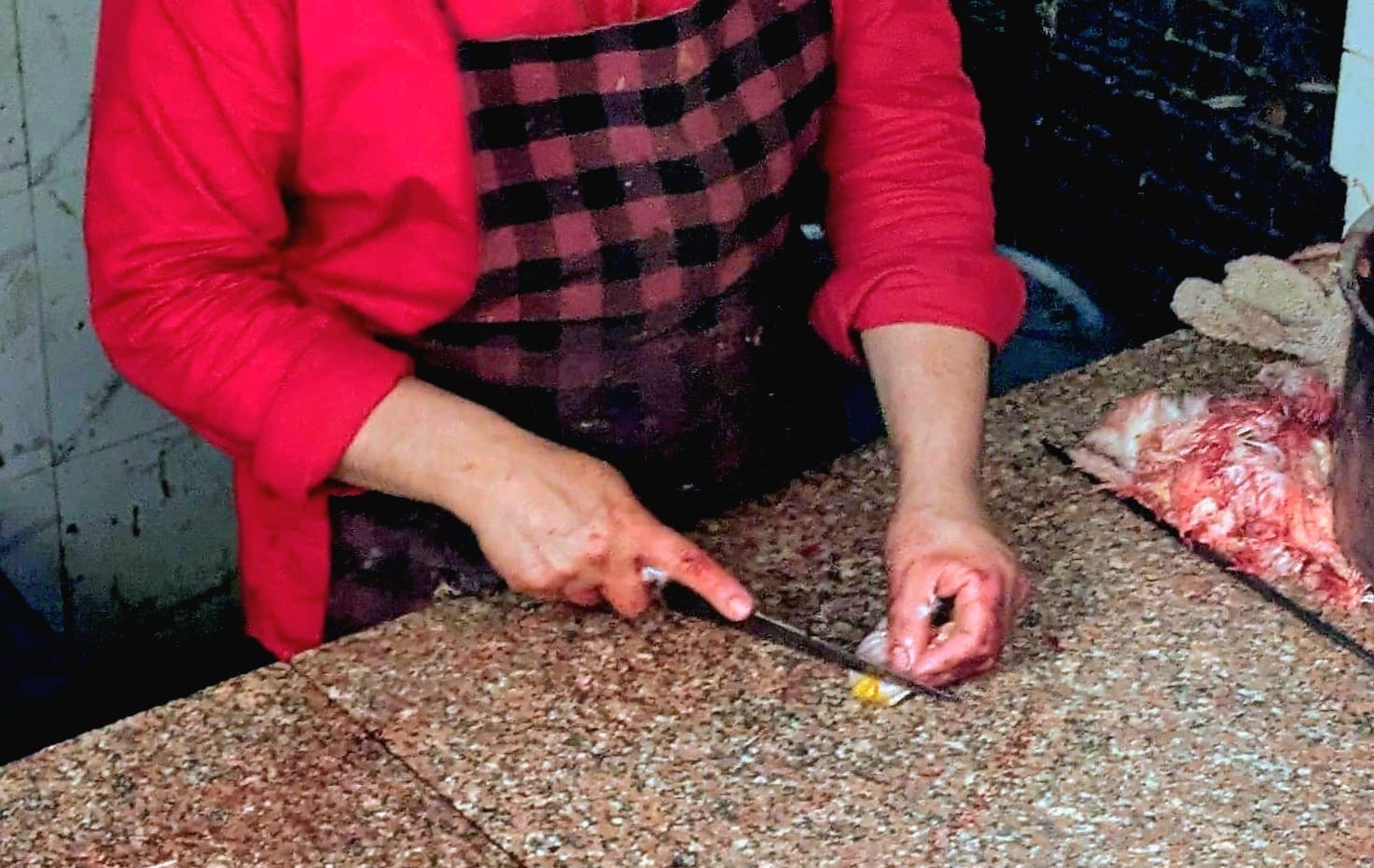
To ask for offal is to locate yourself on a social map. The counter only serves those who have the privilege to eat meat openly. In contemporary Delhi, the gentrification of food culture has produced a curious phenomenon. A younger, mobile urban class is increasingly consuming a wide variety of foods, including meat, which can be found in trendy restaurants and the aforementioned polished butcher shops with pre-packaged products. In a ‘fresh meat shop’ located in central Delhi, there will be a separate corner assigned for offals, but then the naming of it will be modified as “premium beja (mutton brain) for rich, creamy dishes” or “premium cleaned gizzard for meaty chicken flavour”.
Fashionably renamed, re-plated, and presented with appropriate lighting, offal’s designation of impurity seems to lift. Certain offal dishes have also been adopted into the repertoire of aspirational restaurant menus presented as gourmet dishes, their origins laundered by aesthetics and the language of “authenticity.” These restaurants give no credit to the lower-caste origins of such dishes. The caste-privileged buyer enters the restaurant freely and selects their position within it — be it gizzard or prime cuts.
Yet everyone else is expected to use the hushed language from the margins. The gizzard-eater in their neighbourhood shop does not get to choose their meat in the same way. For them, offal is not a curated choice, nor can they enter the restaurants that offer this choice. Their choice is already decided on by the structures of society and it remains so regardless of how many tasting menus appropriate its name. Such is the architecture of food in the segregated capital, and so it will remain until the hierarchy of caste is dissolved.
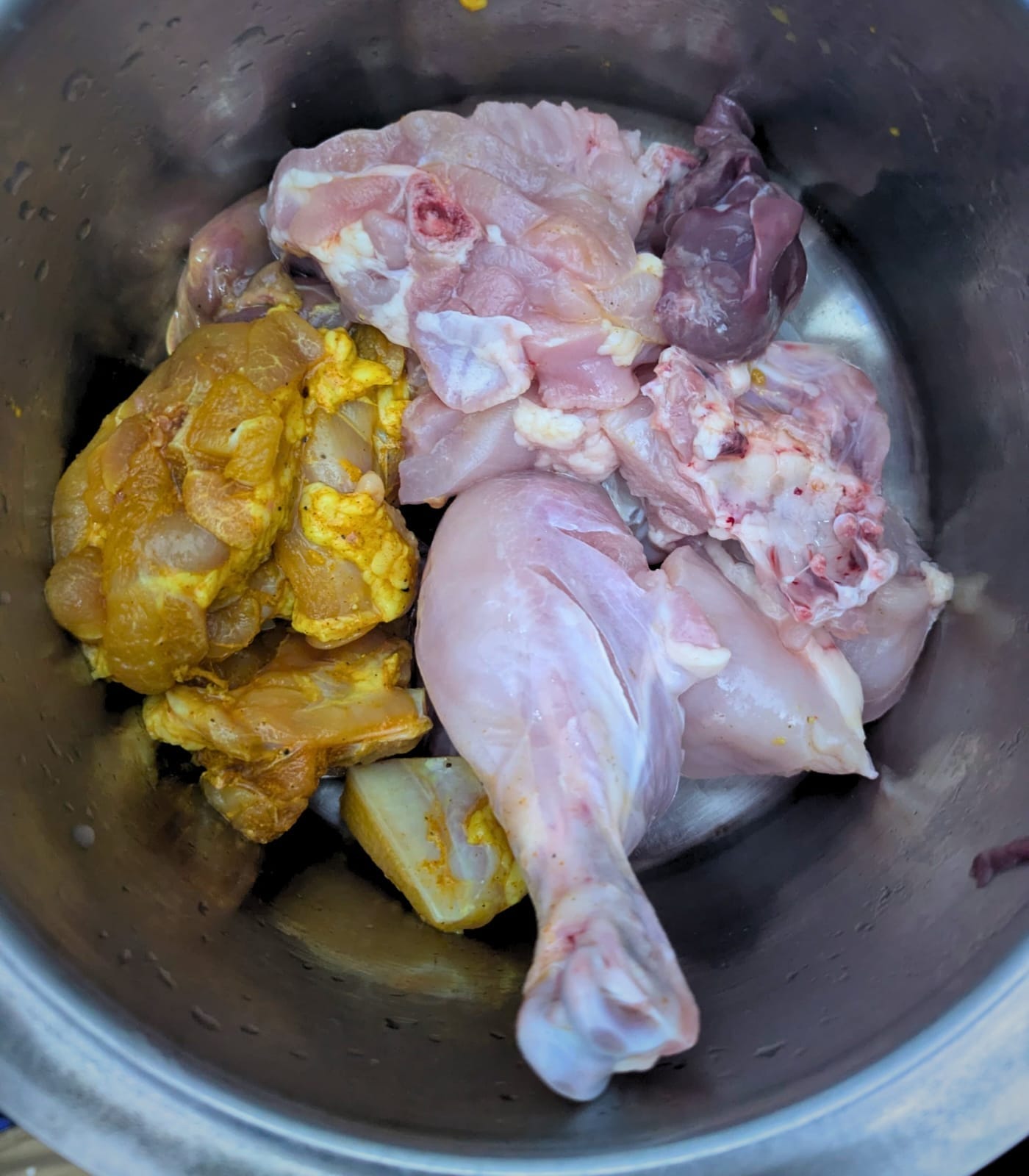
At the table, everything converges. The prime cuts arrive with their associations intact, their presence announced by shared plates and the social performance of appetite.
Somewhere on the same table, or another table in another part of the city, the gizzard arrives without ceremony, eaten by hands that perhaps handled it earlier in a different context. Labour and desire sit together, and are eaten together. The prime cut remembers nothing of the hands that held it. The gizzard carries everything. To center the offal is to insist on the dignity of what sustains. It is to refuse the amnesia of the polished counter.
The meal is complete. The plates are cleared. The hands that made it possible have already left for the day. The city rearranges itself in the dark as it eats its own foundations. We call it dinner.
Nandana Hareesh is a photographer and researcher interested in understanding cities through the lens of caste, identity and belonging. She is a graduate of Tata Institute of Social Sciences. Her research has primarily focused on gender and labour rights, including year-long projects with fisherwomen in Kerala and migrant women workers in Bengaluru, Karnataka.
Ritika Sharma is an artist & researcher from India, working at the intersections of queer futures, climate justice, and community well-being in the Asia-Pacific. They work across mediums including writing, visual arts, and participatory art practices. Their past work explores themes of decolonial queer ecologies, feminist care & joy, women and forest rights, and gendering of public spaces. They currently co-create a collective working at the intersections of community mental health, climate action and gender justice through play- and art-based methods.
According to a 2018 study, 30% of Delhi's residential neighbourhoods contain no Dalit or Adivasi communities at all, and nearly one in three blocks operates as though this population does not exist (Article 14, 2022). Muslims and Dalits face the worst residential segregation in Indian cities, with Delhi being one of the largest metropolises among those, having the poorest public services, from housing to basic access to water.
The Citizenship (Amendment) Act (CAA), 2019 creates a faster pathway to Indian citizenship for undocumented Hindu, Sikh, Buddhist, Jain, Parsi and Christian migrants from Pakistan, Bangladesh and Afghanistan who entered India by 31 December 2014, while excluding Muslims from this religious classification. The Citizenship Amendment Act, hence, is violative of the ‘secular’ fabric of our constitution, as it is making a law while giving preference to certain religions — thereby giving an impression that the state is unfavourable towards one religion, which a secular state is not supposed to do.