

At the turn of the 20th century, Yiddish anarchists in North America threw Yom Kippur Balls: raucous parties replete with pork and cigarettes to satirize the most solemn of holy days. Looking back at these parties through the eyes of revolutionary figures like Emma Goldman, writer and organizer Jesse Roth asks what the contemporary left can learn from these ancestors’ successes — and their mistakes.
By Jesse Roth for our CELEBRATE issue
“Music, dancing, buffet, ‘Marseillaise,’ and other hymns against Satan.”
So read the ticket to a 1890 Yom Kippur Ball in Brooklyn. Thousands of Yiddish anarchists met at a hall on the holiest day of the Jewish calendar — and they did so in London, Montreal, Baltimore, Philadelphia, and Chicago, too. But at these events, there was no fasting or atoning for sins. On the buffet? Pork. On the agenda? Sermons satirizing Jewish liturgy, a protest against the intrinsic bond between religion and the state. And the rabbis proved them right; enraged by the sacrilege, they called in the cops.
More than a century later, the Israeli ethnostate is committing genocide against Palestinians, having killed at least 72,469 people in Gaza over the last two years (the death toll, according to some experts, could be as high as 680,000). With backing from the US, they’ve also attacked Iran and Lebanon, with the violence threatening to escalate into an even larger war.
In fealty to this genocidal, apartheid nation state, many US Jews are allying themselves with the neo-nazi-enabling Trump government. Mainstream Jewish institutions are choosing state violence (at home and abroad) in an attempt to secure (fleeting, false, conditional) “safety” for the Jewish people.
As fascism, white nationalism, and geopolitical crises escalate across the globe, more and more people across identities will be offered this devil’s bargain: turn on “others” to (supposedly) save yourself. But some of these Yiddish ancestors knew — in picnics and parties, mutual aid groups and worker coops, schools and libraries, assassinations and streetfights — a safety greater than Empire. They understood that pleasure and celebration are fertile soil for revolutionary organizing; we have so much to learn from them today.

A key figure of the turn-of-the-twentieth-century left (and a frequent Yom Kippur Ball attendee) was the revolutionary Emma Goldman. In 1899, at twenty years old, she arrived in New York City with just five dollars, a handbag, a sewing machine, and three addresses — one of which was for the office of a German anarchist newspaper, the Freiheit, or “Freedom.” Emma had come to New York to immerse herself in the rapidly growing anarchist political scene, newly radicalized by news of the Haymarket Affair.
The Haymarket Affair took place in 1886 in Chicago, when workers, immigrants, and anarchists demonstrated for an eight-hour workday. 180 police brutally attacked the protestors. Amidst the attack, a bomb of unknown origin exploded. Chaos ensued, including police firing on demonstrators and each other. The bomb and police crossfire killed an untold number of demonstrators and eight police officers. Eight anarchists were prosecuted for conspiracy to murder a policeman, though it became clear throughout the trial that they had had nothing to do with the bomb.
Emma was not alone in radicalizing in response to the brutality: as one organizer and historian wrote, “Anarchism in America received its baptism in the blood of the Chicago martyrs.” Anarchism, a political tradition born from Eastern European socialist organizing in the 19th century, fundamentally opposes domination and hierarchies of all kinds.1 While socialism and anarchism have a shared enemy in capitalism, anarchism also opposes the domination of a centralized state. For over a century, anarchists have fought against private property, borders, nation-states, police, prisons, patriarchy, imperialism, and capitalism.
From the ashes of these systems, anarchists seek to build a world based on mutual aid, voluntary cooperation, direct action, and collective decision-making. Yiddish anarchism, in particular, came from the Jewish experience of statelessness, of being a diasporic people who always lived (until the invention of “Israel”) outside of and beyond the nation state. As scholars Kenyon Zimmer and Claire Ehrlich say, “Jewish anarchists didn’t have to unlearn nationalism.” Instead, they turned toward language, literature, and culture to create communal bonds — a praxis encapsulated by the late Yiddish Anarchist and newspaper editor Ahrne Thorne’s assertion that “Yiddish is [my] homeland.”
Contemporary Yiddish Anarchist scholar Anna Elena Torres writes, “Some people might assume that because anarchists believe in the abolition of borders, they also believe in the abolition of difference.” Yiddish anarchists fought fiercely against assimilation and universalism. Their understanding of Jewish-ness was fluid and self-determined: many anarchists were avidly anti-religious, others grounded their anarchist beliefs in the holy texts. Some weren’t actually Jewish, but were welcomed into Yiddish anarchism, like Rudolph Rocker, a gentile, who comrades called an “anarchist rabbi.” The Yiddish anarchists practiced building culture without policing its borders.
In the decades after Emma’s arrival in New York, Yiddish anarchists played a crucial role in the labour movement in the United States, organizing large-scale strikes. Some, including Emma and a great number of other anarchist women, also protested military action, agitating against WWI in a campaign that led to decades in prison for many organizers and Emma’s eventual deportation to Russia.2
In the meantime, they also threw good parties.
On September 24, 1890, Emma and 5,000 other Jewish anarchists arrived at the Labor Lyceum in Brooklyn for a “Grand Yom Kippur Ball. With Theatre.” On the ticket, the Yiddish Anarchists invited their comrades to celebrate the beginning of the Hebrew year 6651, satirizing the actual new year 5651. Yom Kippur closely follows Jewish New Year, and is traditionally a holiday of atonement, fasting, and piety. Yet on this occasion, men walked down the street with cigarettes in their mouths, pork in their hands, “growling the Marseillaise.” They were anticipating a reading of a satirical Kol Nidre (Yom Kippur Liturgy) from leading German anarchist Johann Most (who soon became Emma’s lover). Like at other Yom Kippur balls being held around the country, there was to be music, dancing, food, and drink.
But Emma and her 5,000 peers never made it inside. They were turned away by “brutal obstruction of the police” and a bevy of angry religious Jews. The source of the leak? Local Rabbi Marcus Friedlander, who, upon hearing of the ball, translated the Yiddish flyer into English, but not without adding mentions of “dynamite” and “bombs.” He then handed that flier to the cops and riled up his own community to shut the ball down, resulting in a “pitched battle” of a street fight.
The Brooklyn Yom Kippur ball wasn’t an isolated event, nor was it the only one to rile up controversy. Over other luxurious buffet tables, these Yiddish anarchists took on organized religion as their enemy #1, believing it to be a primary barrier to people rising up in revolution. Joseph Cohen, one of these anarchists and a historian, wrote:
We have the historical record that the church served the rich and the powerful everywhere and at all times and helped to keep the people enslaved and in ignorance, poverty, and need. Religion in this sense is really the opium of the people — the worst and most harmful infestation, from which we must try with all our might to free ourselves before we can begin to think about changing the political and economic structure of society.
In 1891, at a Philadelphia ball, a religious Jew and a Jewish cop (Cohen called him “a red-baiter and a rat”) falsely accused five men of inciting violence against politicians in their speeches.3 In 1890, in Baltimore, they served ham sandwiches at a “town hall” where an Orthodox Jew and an anarchist were to debate “Are religion and socialism compatible?” before an audience of 1,000. The Orthodox Jew spoke first, but before the anarchist could respond, someone yelled “Fire!” and the audience fled in chaos. A “lavish spread of ice cream, pickles, cake, and cream puffs” was served at a 1905 Chicago Ball, where famed anarchist Lucy Parsons was a keynote speaker.4 Just as Parsons was about to step onstage, the police arrived and intervened. She backed down. The following day, a headline in The Daily Inter-Ocean read “Anarchists Have Degenerated into Eaters of Ice Cream Puffs Instead of Drinkers of Blood and Throwers of Bombs.”
Though many (then and now) have scoffed at Yom Kippur Balls as frivolous and counterproductive “tomfoolery,” these joyful, militant, and cheeky celebrations revealed the intrinsic collusion between “State and Synagogue;” rabbis were repeatedly willing to turn to state violence to protect their institutions. Though the ball organizers were anti-religious, they were deeply Jewish, riffing off of and having fun with Jewish traditions.
These events were valuable places for base-building: radicalizing young people and bringing them into the movement where they would study, organize, and struggle together. Tasked with helping organize young women into a strike, Emma helped assemble “concerts, socials, and dances.” She writes that “at these affairs, it was not difficult to press upon the girls the need of making common cause with their striking brothers.” Emma felt she was “one of the most untiring and gayest” at the dances — until one night when a boy called her “undignified” and “frivolous.” In return, she made a ferocious speech, decrying ascetic radicalism and calling for an anarchism full of life and joy. “I want freedom, the right to self-expression, everybody’s right to beautiful, radiant things,” she said. In her memoir, Emma matter-of-factly states that parties were the easiest place to organize young women, and she quickly rebuked anyone saying that the movement should be less fun.
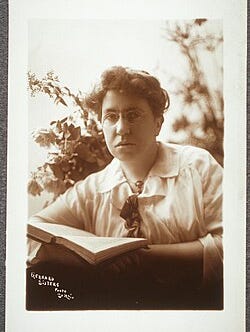
Emma and her comrades understood that the means and the ends were one and the same: The act of making a revolution must be as fun and delicious as winning one. This philosophy applied to the support they built into everyday life, too. Along with the balls and parties where they would gather to riff on Jewish traditions, Yiddish anarchists created an “anarchist minhag,” or “way of life:” libraries, schools, housing and worker coops, newspapers, mutual aid associations. These organizers built institutions that wove radical politics into their everyday lives, creating spaces for cross-pollination and politicization over food and drink.
In her autobiography, on her very first day in New York City, Emma ended up at Sachs café, the “headquarters of the East Side radicals.” Before she knew it, she met her future beau Alexander Berkman, as well as two other soon-to-be lovers and a roommate — all dedicated comrades. She later went on to found her own café (with Berkman and Feyda, one of the other lovers): an ice cream parlour in Worcester, Massachusetts. With ice cream, sandwiches, coffee, and “dainty dishes,” the polycule5 used their earnings to fund Berkman’s attempted assassination of strikebreaker Henry Clay Frick.
Joseph Cohen describes how elsewhere in the city, Annie Netter, an “indefatigable” organizer (and a participant in a Baltimore Yom Kippur Ball) and her parents opened their home to ensure that “not only to comrades but to anyone in need” could have a helping of soup (with plenty of meat) for just a few cents, nurturing young radicals and supporting intellectual exchange.
Yiddish anarchists also organized cooperatives for housing, work, and mutual aid, prefiguring the kind of collectivist life they dreamed of. The primary organizing force behind these co-ops was The Workman’s Circle, an organization founded in 19006 that served socialists and anarchists across North America and, at its height, boasted more than 80,000 members. The organization provided healthcare, unemployment, life insurance, elder care, housing co-ops, and burial services to its members. It also operated a Philadelphia cooperative bakery and shoe store, which opened with an enormous parade, scored by a marching band and led by bakers in white aprons “displaying on a cart a challah as big as a house.”
For several years, some Philadelphia organizers also created a Yiddish anarchist summer camp full of celebrations, art, play, and food, which took in the children of women picketing during a textile workers’ strike in New Jersey.7
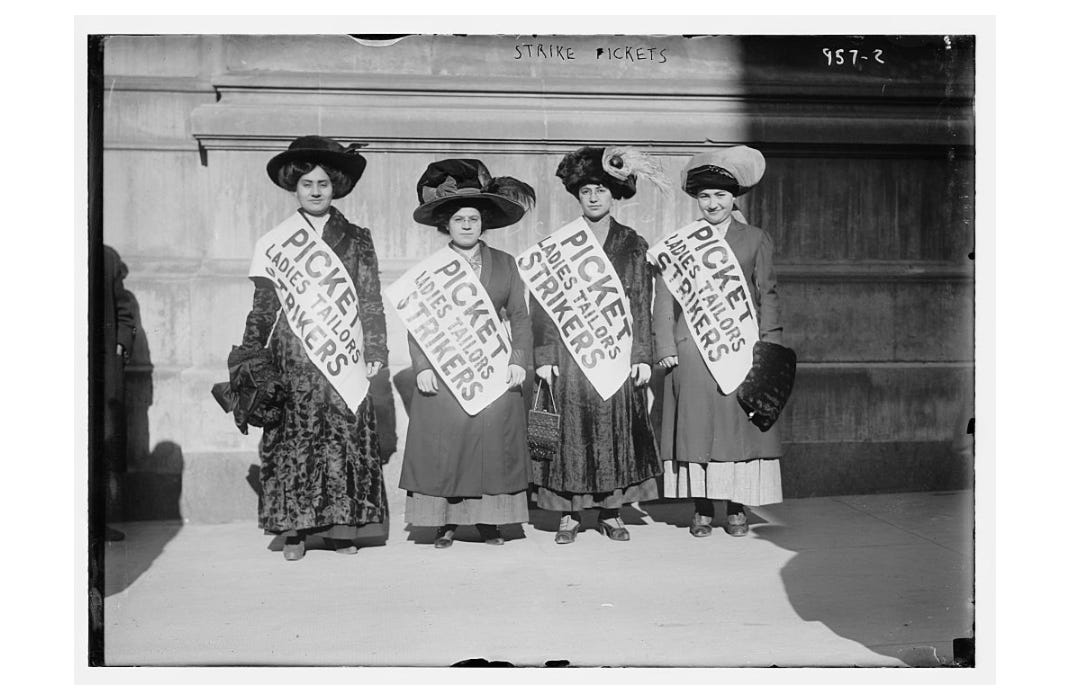
In essence, these organizers used care infrastructure and hospitality to build a base. With songs, ice cream, ham sandwiches, cafés, cooperatives, and thousands of comrades, these organizers built culture to fight against the state.
Over the first half of the twentieth century, the anti-state politics of these anarchists would be tested, however, by escalating anti-semitism across Europe and the growing popularity of a supposed saviour: zionism.
Today, the dominant cultural story is that all Jews have always supported zionism. But mass movements of Jews across the world — including many Jewish anarchists — opposed this ethno-nationalist movement since the beginning. Zionism and its supremacist promises, however, were unfortunately seductive to some leftists. A sect of Yiddish anarchists fully abandoned their anti-state politics and became zionists, imagining that this nation-state would save them. Other anarchist “cultural zionists” or “labour zionists” attempted to create an anarchist/socialist “utopia” in Palestine, forming the beginning of the kibbutz movement on stolen land, systematically excluding Arabs and creating the key building blocks of what would become the Israeli state after the Nakba of 1948.8
Even Emma Goldman herself insisted that while she opposed zionism as a capitalist project, Jewish workers had “reclaimed wastelands and have turned them into fertile fields and blooming gardens,” (repeating the zionist myth of “making the desert bloom”).9 “The land should belong to those who till the soil,” she wrote, claiming that in her understanding of socialism, Jews have as much claim to the land as Palestinians. Emma’s fantasy of a socialist utopia made her unable to reckon with the ways zionism, as a colonial project, uses working-class Jews as pawns. Even while opposing zionism, she repeated its propaganda.
Other Jewish radicals opposed zionism at first, but later abandoned their politics as Palestinian’s (rightful) resistance to zionism grew more militant. In the midst of the Palestinian Arab uprising of 1929, the editors of a leading anarchist Yiddish newspaper changed sides, writing, “Our last and only hope — a sad and regretful hope, there is no question — is to create within ourselves, in our own people, the power to strike back and fight violence with violence.” In the same letter, they call Arabs “savages” and spread the rhetoric of Palestine being “a land without a people”.
Not everyone jumped ship. In the same newspaper, a group of Polish anarchists struck back, arguing that the anarchist paper had “granted a reactionary ideology citizenship in their minds.” They argued that the British Empire was practicing “its colonial murder and politics of theft” and that the “Zionist devil” was doing their dirty work for them. They decried the “foolish chutzpah against the Arabs” they saw in Jewish settlers. They underscored that Jewish immigrants were stealing land from Palestinians, “land which they and their ancestors worked for generations.”
Meanwhile, the Jewish Labor Bund, a Yiddish leftist group prominent in Eastern Europe, centered its politics around the Yiddish concept of “doykeit” or hereness — building liberation, solidarity, and comradeship in the here and now, without dominating others in the process. Grounded in this concept, the Bund was fiercely anti-zionist. While many other Eastern European Jews turned to zionism and fled as the Nazis gained power, the Bund demanded — through political organizing, culture, and armed struggle — their right to freedom and safety right where they were.
“[Zionists] forget all the lessons of history that have been written with rivers of blood over the last two thousand years,” wrote Joseph Cohen in his 1945 book The Yiddish Anarchist Movement in America. “Sooner or later, humankind will have to come to the conviction that the state cannot solve the serious problems of society because the state is itself a contributor to social problems.” In Cohen’s view, the state — armed, powerful, and privileged — was the root of oppression. Its rulers would never understand the challenges faced by their subjects; the only alternative was to create a network of voluntary organizations that would build an egalitarian society without exploitation, force, or hierarchy. Any state, even a so-called Jewish one, was not to be embraced.
Despite these voices of clarity, Yiddish anarchism’s eventual demise came through a cocktail of assimilation, zionism, and repression. Post-war, in the US, Ashkenazi Jews were offered more and more benefits of whiteness in exchange for leaving Yiddish (their homeland) and culture behind. The US government also took aim at the left through both Red Scares (periods of intense public anxiety over the supposed rise of communism), including targeting Jews in the US for both supposed and actual communist organizing. Meanwhile, the zionist movement out-organized our anti-state comrades.10 Many Jews, including those on the so-called “left,” joined the state-building project that became “Israel”— killing, stealing the land, and attempting to destroy the culture of Palestinians.
Our present moment is a continuation and escalation of the zionist project. While it has been over a century since the Yiddish anarchists and the synagogue boys faced off at the first Yom Kippur Ball, these contradictions between and within Jewish communities remain as a parable for our times. Like over a century ago, while some Jews fight against the state, others ally themselves with its violence — the cops, the Neo-Nazi aligned Trump administration, the Israeli army, and the international frameworks that protect them
On April 28, 2025, in Brooklyn — where the Grand Yom Kippur Ball was hosted over 130 years prior — a group of pro-Palestinian activists, led by the group Within our Lifetime, protested a speech by Itamar Ben Gvir (the zionist regime’s national security minister and a key architect of the genocide). In response, over a hundred conservative Jews chanted “Death to Arabs” while threatening, hitting, and throwing garbage cans and traffic cones at protestors. Outside the synagogue where the speech was being held, they shoved a Jewish woman on the Palestinian side to the ground, where she lay bleeding from the head. (Some reports say they attacked her with a brick.) In a post on Instagram, the attacked woman writes, “The only thing that gives me some joy is that while zios were celebrating and laughing at me i’m over here thinking yall hit a Jew w. A damn israhelli passport!! Great job.” She shares a photo of her bloodied face with a keffiyeh over her head, cowering as the men surround and attack her.
For decades, and more intensely every day, the zionist project wields state violence in the name of “Jewish safety”. As former President Joe Biden said dozens of times, “Were there no Israel, there’s not a Jew in the world who will be safe.” The zionist state’s public relations apparatus (hasbarah) has made a decades-long project of branding all pro-Palestine speech as antisemitic—all while cozying up to the neo-Nazi-adjacent right wing.11
Just before the 2024 election in the US, the Heritage Foundation, a right-wing think tank, released “Project Esther: A National Strategy to Combat Antisemitism.” This strategy, created by Christian zionists and named after a biblical Jewish Queen, targets a “global Hamas Support Network,” including organizations such as Students for Justice in Palestine, American Muslims for Palestine, and Jewish Voice for Peace. Since coming to power, the Trump administration has been running the Project Esther playbook, releasing two executive orders on “combating antisemitism,” giving them a pretense to deport, investigate, punish, and prosecute “anti-Jewish racism,” “pro-jihadist” protestors, and “Hamas sympathizers.”12
Thus, within global Palestinian solidarity movements, the Jewish anti-zionist left has taken up a key role in attempting to refute this zionist propaganda: How can you say this genocide is in the name of Jewish safety, when thousands of us are telling you it’s not? This encampment can’t be antisemitic; hundreds of Jews are lighting Shabbat candles. We argue that Jewish safety comes through solidarity; our safety and liberation are bound together with those of all other oppressed peoples.
While right-wing Jewish institutions might say we are “self-hating Jews,” contemporary anti-zionist Jewish organizing is actually a deep well of spiritual devotion and practice. Perhaps to the chagrin of our cigarette-smoking, pork-eating ancestors, ritual and scripture often guide our efforts for community, nourishment, cultural organizing, healing, reclamation, and civil disobedience. Many actually see anarchism and non-secular Judaism as complementary: In his essay “Of Performing Mitzvahs and Toppling Kings,” Stephen Gee writes, “There is no talk of an afterlife in Judaism; the focus is on what you do while you’re alive.” In a moment when zionists are attempting to equate the Jewish religion with a genocidal project, and Christo-fascists are appropriating Jewish texts to deport our comrades, divinity and ritual are contested terrain; we can’t cede them to the right wing without a fight.
As weight to separate Judaism from zionism, we must also heed our Yiddish ancestors’ mistakes. Over a hundred years ago, though a critical mass of the Jewish left stood firm against zionism, too many comrades — including Emma Goldman — waffled or changed sides, engaging in the Western rhetoric of settler colonialism. Today, the anti-zionist Jewish left falls into a similar trap, often centering modern Western constructs like the nation-state and international law over anticolonial frameworks. We’ve spent countless hours calling our lawmakers; thousands have been arrested for civil disobedience, and we’ve spilled endless ink trying to convince politicians to stop the mass murder of children. We appeal to the supposed neutrality of “international law” to decide what constitutes a war crime or a valid form of self-defense. Like a hundred years ago, when Emma supported Western socialism over Indigenous claims to the land, the Jewish left is making our commitments to collective liberation contingent on Western political constructs.
But the nation-state and its international bodies have no morality. Its leaders — “left”, right, and center — endorse and cravenly send billions of dollars to enact this mass violence. Politicians parrot stock sentences on the state of Israel’s right to defend itself when it is, in fact, an occupying power. Instead of working within these limiting constructs, the Jewish left must, in the words of Omar El Akkad, “look at the West, the rules-based order, the shell of modern liberalism and the capitalist thing it serves and [say]: I want nothing to do with this.”
If we’re going to walk away from the Western nation-state, then we have to create our own sources of safety, care, and pleasure. In our present moment, it’s tempting to ditch culture in the face of ever-escalating genocide and fascist violence; to pivot to a politics of survival, to treat a library, a newspaper, a dinner, a play, or a poem as silly and extraneous. In the words of a cynical turn-of-the-century journalist, how dare we eat ice cream puffs when we should be drinking blood and throwing bombs?
But our enemies are not so naïve: they are intentionally destroying cultural organizing and social infrastructure because they understand and fear its power. The Trump administration has cut funds to libraries and arts organizations en masse. They’ve defunded public broadcasting and hit newsrooms with FCC investigations. They’ve cut food stamps and food safety investigations. Meanwhile, the Israeli state shells, detonates, loots, and sets fire to libraries containing rare books, hundreds of years of knowledge, precious religious texts, and sheltering families. They’ve slaughtered over 270 journalists, many in targeted drone strikes, while keeping a propaganda chokehold on the Western media. They’re using starvation as a weapon of war. They’re destroying olive trees and attacking Palestinians harvesting traditional foods. They’re jailing and beating theatre directors. They’re targeting Palestinian poets, whose words are, according to an Israeli general, “like facing 20 enemy fighters,” (as quoted by the martyred poet Refaat Alareer).
Yiddish Anarchists understood that cultural organizing is essential to creating a world beyond the nation-state. They built an astonishing amount of movement infrastructure — summer camps, libraries, schools, and newspapers — all while working 13-hour days in garment factories. The contemporary left is working on it: We’ve built popular universities at encampments, drag shows, solidarity economy projects, community gardens, protest kitchens, and the massive web of mutual aid networks that emerged during the early COVID-19 pandemic. But as the feeble support offered by the state for our social welfare erodes under fascism and climate collapse, we need to scale this more than we can imagine. In essence, we must consider how to recreate the concept of doykeit: creating the communities necessary to survive, win, and enjoy each other and our lives in the here and now.
So let’s roll up our sleeves and cook vat after vat of chicken soup, with shmaltz floating on top. Let’s deliver it to drawn-out strategy meetings in comrades’ living rooms; to mutual aid groups feeding unhoused neighbours on freezing nights; spoonfed to activists chained to the doors of weapons manufacturers; to jail support teams receiving cop-battered friends at 4 AM; to fundraisers sending cash to families in Gaza desperate to afford a $300 bag of flour. As organizer Cindy Barukh Milstein writes, “As both an anarchist and a Jew, I’ve long dreamed of do-it-ourselves, egalitarian forms of social organization — ones in which we’re all reciprocally and abundantly cared for, not to mention messy-beautifully whole.” Our bubbes — those women from long ago who cooked for radical summer camps, shilled ice cream to fund assassins, and ate pork on High Holy Days — might be proud.
Jesse Roth is a writer, theatre artist, and organizer of Jewish descent. Her writing has been published in The Stranger and Truthout. She writes I Have a Ribcage; You Have a Ribcage, a newsletter of auto-criticism on art, politics, and the divine. She lives in Seattle’s Capitol Hill neighbourhood.
Anarchism is far from alone in these ideals, sharing overlapping (but far from identical) politics with anti-state movements from around the world. Anarchism shares praxis with Indigenous groups in North America, some of whom identify as anarchists themselves (such as the Indigenous Anarchist Federation and writer/artist/organizer Knee Benally). There is also a significant history of anarchism within the Black radical tradition (including thinkers like Kuwasi Balagoon, Lorenzo Kom’boa Ervin, and Saidiya Hartman) and meaningful overlap between anarchism and abolition, which is leading the charge to end police, prisons, and racial capitalism. Palestinians, through political, economic, cultural, and armed resistance, have been resisting the state since before zionism (relatively recently) enacted its statehood at gunpoint. As Palestinian Anarchist Beesan Ramadan says, “People have already done horizontal, or non-hierarchical, organizing all their lives.”
They were also responsible for two high-profile assassinations: an attempted assasination of Henry Clay Frick, a strikebreaker in 1892 and a successful assassination of President William McKinley in 1901.
All five were sentenced to a year in prison. One of the men was neither an anarchist nor a speaker, but as a cigar maker who also walked with a limp, he simply resembled the actual speaker in question.
Parsons was born enslaved, before marrying Albert Parsons, who was hanged as one of the Haymarket martyrs. She became a ferocious speaker and organizer, helping found the Socialist Party of America, the Industrial Workers of the World, and the Chicago Working Women’s Union.
Yiddish anarchism had early feminist leanings: Women in the early 20th century rejected marriage, were breadwinners, divorced their husbands, got arrested at demonstrations, had abortions, served prison sentences for their dissent, sent their children to radical schools, were attacked by strikebreakers (with lifelong scars to prove it), organized powerful unions like the International Ladies Garment Workers Union, agitated for access to birth control, raised children collectively, became lesbians, became vegetarians, and practiced polyamory.
The workmen’s circle is still around today, now called The Worker’s Circle.
It was a common Industrial Workers of the World (IWW) strategy, created by Matilda Rabinowitz in 1912, to send children away during strikes to offer both childcare and protection from anti-union forces.
Kibbutzim served as the foundations of the Jewish Israeli economy, national trade unions, a landing place for mass immigration, and physical, agricultural, and industrial infrastructure. One scholar calls the Kibbutz “the real nucleus of Israeli state formation.”
Emma wrote this in response to arguments from British Quaker, socialist, and anticolonial activist Reginald Reynolds when he wrote a compelling analysis of settler colonialism (without using those words). Reynolds warned against the mass immigration of Jews to Palestine, arguing that British and zionist elites were using it to secure economic and military power.
Importantly, globally, there are vastly more Christian zionists than total Jews. The coalition that out-organized Yiddish anarchists was made up of a massive group of Christians, capitalists, zionist Jews, and imperialists.
While Pro-Israel Jewish institutions such as AIPAC (American Israel Public Affairs Committee) and the ADL (the Anti-Defamation League) continue to attack the anti-zionist left (including Jews) as “antisemitic”, they are also getting in bed with right-wing, white nationalist, neo-Nazis. During the last election cycle, AIPAC funded QAnon conspiracists, election deniers, transphobes, and — importantly — candidates espousing the quintessentially antisemitic “great replacement theory.” Elon Musk performed a Sieg Heil at the inauguration, and the ADL defended it as an “awkward gesture.” The pro-Israel lobby accuses the left of antisemitism while funding and defending actual nazis.
The Trump administration has used these executive orders to detain and attempt to deport activists Mahmoud Khalil, Rümeysa Öztürk, Yunseo Chung, and Mohsen Mahdawi. Trump also pulled $400 million in funding from Columbia University for insufficiently punishing “antisemitism” on campus (despite the police’s brutal attacks on student protestors). Columbia bent to the administration’s demands, increasing policing of student protestors, banning masks, and accepting government oversight of the Middle Eastern, South Asian, and African Studies Department. When Harvard stood up to a similar threat of losing $2 billion in funding, the Trump administration threatened to revoke its tax-exempt status.
'The contemporary left is working on it: We’ve built popular universities at encampments, drag shows, solidarity economy projects, community gardens, protest kitchens, and the massive web of mutual aid networks that emerged during the early COVID-19 pandemic. But as the feeble support offered by the state for our social welfare erodes under fascism and climate collapse, we need to scale this more than we can imagine. In essence, we must consider how to recreate the concept of doykeit: creating the communities necessary to survive, win, and enjoy each other and our lives in the here and now.' Agree we should be upping the anti, not allowing ourselves to be eradicated!
Incredible 👏🏻