

Editor’s note: Welcome to the official launch of CELEBRATE! Our ninth issue explores what it means to celebrate in our current moment: to come together, to mark time, to honour both the sacred and the everyday, and to pursue pleasure without losing political clarity.
We hope you enjoy this first piece, which takes us to the splendid food tables and complex catering kitchens of southern Nigeria. Having stood both behind the cooking pots and among the guests at Nigerian celebrations, writer Tracy Egbele examines the ways in which party food reflects complex gender dynamics and intricate social hierarchies. - IJbV & ZJ
Takeaway: The Politics of Nigerian Party Food
By Tracy Egbele for our CELEBRATE issue | Premium subscribers have access to an audio reading on our podcast.
In gatherings and celebrations, Nigerians are extra — especially when it comes to food. Any occasion, even a funeral, is one for a feast. At my grandfather’s burial in the southern city of Emu, the offerings were abundant and varied: from jollof rice (the undisputed star of Nigerian events) to black soup with pounded yam, egusi soup, ogbono soup, peppered meat, and suya.1
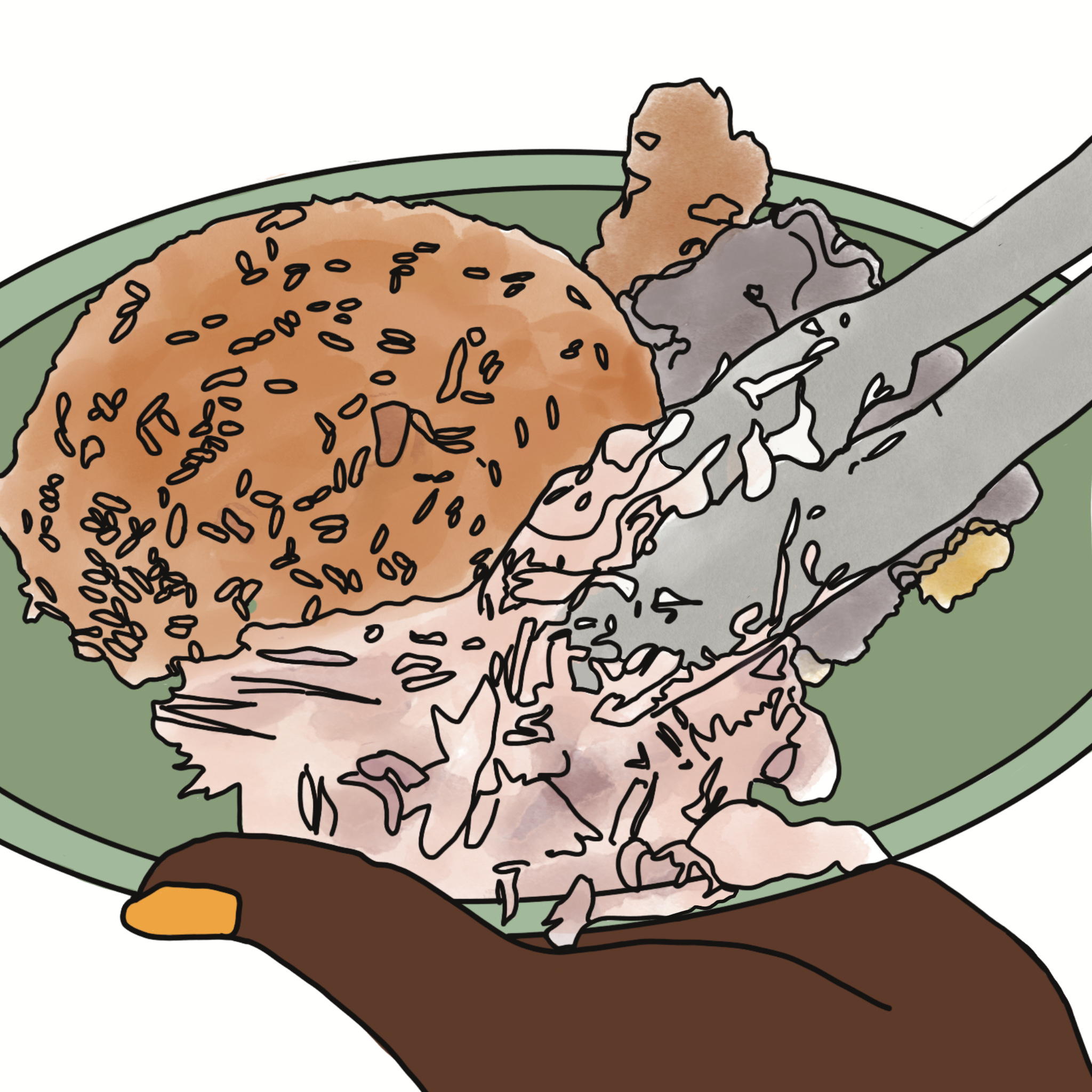
Behind the food stood a formidable team. Among my people, it’s customary for women from the family or clan to come together to cook during funerals, as a means of supporting the grieving family. At this particular event, the cooking duties were divided among my mother and her catering team; one of my aunt’s friends, whom she had brought to help her, and our kinswomen. My mom and her catering team prepared jollof rice and peppered meat. Our kinswomen assisted with the black soup and pounded yam, while my aunt’s friends took on the egusi soup. Once the cooking was done, coolers were brought out for food meant for the community elders and certain groups. But before any of that was shared, my mom made sure that every woman who helped, including our kinswomen, received a generous portion of the dishes they worked on.
I remember watching the women who made the egusi soup serve themselves first. This is fairly common — but they didn’t stop there. They quietly took nearly all the meat used in the soup. Later, when it came time to serve the rest of the guests, we realized they had taken more than half the pot. Such are the politics of party food in Nigeria, where hierarchies and preferences are enforced over plates of food. While the preparation of food for these events is often labelled “just cooking” or “a woman’s job,” the women behind the pots wield their serving spoons with intention, deciding what is served, how much is served, and to whom. In Nigeria, catering is a form of power — one that reveals not only tensions over gender norms but also social inequalities, favouritism, and corruption.
Growing up as the daughter of a caterer, I was often assigned simple tasks in my mother’s catering team: fetching water, picking vegetables, helping to wash the pots, or tasting the food or adjusting the seasoning (my favourite). As I got older and more experienced, I began participating fully — cooking large batches of banga rice, pepper soup, and coleslaw.
Around me, I watched my mom and other women transform open, bare spaces into bustling kitchens alive with the sounds of crackling firewood, laughter, gossip, and the occasional argument. Each woman had her role: arranging the firewood, rubbing the big pots meant for cooking with detergent, oil, and sand (to ease washing off the black stains from the pot when the cooking is over), washing the bags of rice (because what is a Nigerian event without rice?), or seasoning the meat.
We were cooking, but we were also doing more. In a society where women are expected to focus on domestic tasks, the kitchen is a space where women who might otherwise be invisible in their homes or public life take centre stage. Knowledge is passed down, women gossip about their husbands, share dreams of their daughters marrying or giving birth (so they too can host the celebratory events we were often cooking for), and even boast about their cooking prowess.
In other public and private spaces in Nigeria, women are generally excluded from positions of authority and decision-making. Across geographic communities in many parts of the country, only men can be king (see endnote). Nigeria also has a huge gender gap in politics: out of 36 ministers in the National Assembly, only 6 are women, and the national average of women’s political participation in Nigeria is just 7% in both elective and appointive positions. Women also account for over two-thirds of the country’s extreme poor. In the workplace, they earn 45% less than men in similar roles on average.
The impact of these statistics was visible in the lives of the women around me when I worked in my mum’s catering kitchens. While we cooked, many women spoke about their struggles, particularly in their youth. One told us that she wanted to start her own printing company, but her family refused, insisting she focus on her marriage. Many others shared stories of how they had been pushed to marry after completing secondary education, which put a halt to other ideas they had for their lives. I would eventually encounter the limitations of gender myself: as a young adult, I felt called to start a farm of my own in my hometown, only to discover that it was not customary in my village for women to own land.
In a society where power is systematically denied to women, catering is one avenue where we have been able to wrestle back a modicum of control. Most of the women who worked for my mother had, at one point, been housewives whose husbands never allowed them to work — but either due to the death of their spouse, divorce, or financial issues, they had decided to earn for themselves. And even if their wages were much less than what their husbands currently or used to earn, catering paid well. Someone on my mom’s team had been a private school teacher, but quit after she realized she could earn more from two days of catering than in one month of teaching. Others owned small-scale businesses on the side and used catering to top up their earnings. When I graduated from university, catering helped me with my expenses while I considered what else I wanted to do. For youth in Nigeria, with the pressure to get a job and find one’s footing immediately, this post-university period can be difficult — but for me, catering was a cushion.
Through catering, women also gain autonomy in other ways. Like at my grandfather’s burial, the cooks have a great deal of freedom to allocate their own portions. Women in Nigeria are more likely to be food insecure than men, as are women-headed households. At my great-grandmother’s funeral, I caught a woman hiding fried meats that were meant to accompany the food they were cooking in her bra. Amidst the bustle of cooking, the chatter, the chopping of firewood, and the flurry of preparing to serve guests, this particular kinswoman discreetly tucked pieces of hot-fried meat into her clothing. She twisted and squirmed as the meat burned her before dashing home with the excuse of needing to relieve herself.
Perhaps it was gluttony — or perhaps it was something else. I’ve seen and heard women talk about starving just so their children could eat, or women whose husbands insisted they eat first since they were the head of the household, and needed more physical strength and energy. Catered gatherings become uncommon spaces of abundance where the women behind the pots can treat themselves.
In Nigeria, we have a popular saying: “‘I know the bride’ does not equal party jollof.”
The way food is shared at weddings, funerals, birthdays, and naming ceremonies can reveal much about a guest’s relationship standing in a highly stratified society. Usually, guests who receive generous portions or are served quickly are those with close ties to the hosts, strong connections with the people running the kitchen, or influential social status. At a wedding I catered for, a man rejected his food because it only had one piece of meat. I was left staring at the generous chicken thigh, trying to understand his dissatisfaction. The bride’s mother quickly explained that the man was a chief (a titled man), and therefore, he deserved more than just one piece of meat.
Party food is a mirror for other social inequalities, and “takeaway” culture is another phenomenon that exemplifies these hierarchies. Nearly everyone who attends a Nigerian event hopes to secure a package of takeaway — extra food given to an event guest to take home. Receiving this package is considered a mark of privilege or favour: while some people leave events empty-handed, those who depart with multiple takeaway bags walk out with their heads and shoulders raised high and a gleam in their eyes.
It may seem like harmless favouritism, but preferential portions and takeaway culture highlight the stark contrast between wealth and poverty in Nigeria. While Nigeria is Africa’s largest economy, it’s mainly a small group of elites that enjoys the burgeoning wealth: someone in the top 10 percent of earners can expect to earn nearly as much as 14 people in the bottom 50 percent. This deep economic divide influences daily life, determining which children attend quality schools, who can afford decent healthcare, and who gets access to jobs or political appointments. In rural areas, especially in northern Nigeria, communities often lack well-equipped health centres and trained personnel, contributing to high rates of preventable illnesses and maternal mortality. Teachers are underpaid, and infrastructure is poor.2
To enjoy access to most essential services, it is easier if you “know somebody.”3 Leadership roles in these institutions are usually dominated by individuals with strong networks, making it difficult for ordinary citizens to influence decisions or benefit equally. A friend of mine once visited a government hospital for eye pain. Normally, patients endure long queues, but because he knew someone in administration, he was issued a card and seen quickly. Similarly, during my university admission process, a girl I had just met in the queue and struck up a conversation with was pulled out of the long screening queue by a relative of hers who worked inside, and she took me with her. Within minutes, we were screened, while others waited for hours.
This reality is mirrored in the way food is allocated during events. Those with close ties to the hosts or individuals of higher social standing receive preferential treatment, such as larger portions of food or dignified seating positions. Others may find themselves marginalized, receiving less or even being overlooked entirely. Many Nigerians, especially women, belong to social clubs; at community events, club members often get bigger portions of food, meat, and drinks.4 At the same wedding where the chief requested that I serve him more meat, the bride’s mother made sure to set aside eight large coolers of fried and jollof rice for her club members. Those who got little food to take home (or, in some cases, none at all) may have perceived it as a subtle indication that they didn’t matter all that much to the bride’s family in comparison.
These dynamics mean that people jostle and negotiate for status, not with all-out wars or treaties, but with small strikes and bribes around the food tables that disrupt traditional inequalities. Upon serving the food, women caterers are the orchestra conductors of the parties, doling out portions to those in their favour and denying those who aren’t. This control is a quiet yet impactful way to assert influence in a male-dominated society. It’s common to see DJs, emcees, and photographers trying to stay in the good graces of those working in the kitchen just to secure a plate. In fact, there are jokes that if you upset the caterers, you might go home hungry. At one of my cousins’ weddings, for instance, the groom’s friends refused to help pound yams for the black soup. When it was time to serve, the women made sure none of them got a taste of that dish. It was their way of reclaiming respect through the food they had laboured to prepare. At a wedding ceremony we once catered, the cake maker approached us with a proposition: a sizeable slice of the decorated cake in exchange for extra plates of some of the food we made. She was hungry to build connections — and to secure her portion of takeaway.
As someone who has stood both behind the cooking pots and among the guests, I know that the way food is handled at Nigerian celebrations isn’t just cultural tradition. Whether it’s a plate of jollof rice at a wedding or a bowl of egusi soup and pounded yam at a burial, food is never just food — it helps us see how privilege, access, and inequality show up in everyday life. These dishes carry the weight of a community of women, a bit of favouritism, and silent struggles. And despite the struggles, there is joy. A plate of food served at a Nigerian event is infused with the laughter shared between aunties and mothers in cooking spaces, their quiet pride of serving food sought after by guests, and the spirit of celebrating life. Nigerian parties are loud, colourful, and full of flavour, underpinned by the stories of women whose cooking brought them to life.
At the same wedding where I accidentally served the disgruntled chief too little chicken, I eventually became very thirsty. However, the group handling drinks refused to give my catering team a single drop, saying we would have to wait until the end of the celebration. When the event wrapped up and I returned to ask for our share, they claimed the drinks were finished. Perhaps they thought that was the best way to show their power.
Not long after, the man in charge of the drinks came to us asking for food. I smiled and replied, “It’s finished.”
Tracy Egbele is a Nigerian writer who focuses on telling stories about everyday life, especially stories that are rarely spoken about. She loves food and cooking as much as she loves to read and write.
Endnote
The woman kings of Nigeria
As mentioned in this article, women are rarely allowed to serve as king in Nigerian communities. There have however, been instances where women ruled as kings in certain kingdoms and tribes across various eras — and their stories are fascinating.
One such woman king was Ahebi Ugbabe of Enugu-Ezike, who ruled as a Warrant Chief and king (Eze) for thirty years. She was exiled at a young age, and she moved to Igala land, where she engaged in sex work, brushing shoulders with powerful men in Igala leadership and British colonial officials. She used this opportunity to become fluent in pidgin English and other Nigerian languages, a skill that proved relevant to her future political ambitions. Her lifestyle gave her access to the Igala King and the British divisional Officer, who helped her return to Enugu-Ezike, and supported her to return to the office of headman, warrant chief, and later king (Eze). As Nwando Achebe writes in The Female King of Colonial Nigeria, “as king, she [Ahebi] performed female masculinities, and superceded all existing male political hierarchy and authority.”
Another king was Alaafin Orompoto, the first and only female Alaafin (political leader of the Yoruba people) of Oyo. The Council of Chiefs refused to make her king after her brothers passed away without an heir, claiming a woman had never ruled as Alaafin. She insisted they allow her to prove she was man enough to be king. According to oral tradition, the council granted her seven days to prove her merit; on the seventh day, she stood in front of the council of chiefs and stripped naked. To the astonishment of the council, she had the body of a man, and that was how she became Alaafin.
Perhaps the most well-known female ruler was Queen Amina of Zazzau (Zaria), who ruled from 1576 to 1610. Queen Amina was born into a royal family; her brother became king after their father’s death, and when he too passed away, she was crowned queen. From an early age, she was immersed in military training, court politics, and diplomacy. She is one of the most popular female leaders in Nigerian history and is highly revered among the Hausa people.
It might seem excessive to those unaccustomed to Nigeria, but in most of our cultures, the death of an elderly person is not just mourned; it is celebrated as a life well-lived.
In rural areas of southern Nigeria, accesing safe drinking water can be a struggle. Residents often depend on rivers, streams, or rainwater collected in reservoirs. Government-installed boreholes are frequently non-functional, either due to poor maintenance or drying aquifers, leaving entire communities without a reliable water source. This stands in contrast to urban centers like Lagos or Abuja, where such basic amenities are more reliably available due to closer proximity to political power, government funding, and private investment.
Such dynamics play out even at the highest levels of power in Nigeria, where political leaders often prioritize family, friends, and close associates over the general population. In 2017, former Imo State Governor Rochas Okorocha created a “Ministry of Happiness and Purpose Fulfillment” and appointed his sister to head it. The move sparked public outrage and was widely criticized as a misuse of public office and a clear display of nepotism.
These social clubs or associations are often formed around shared interests, ethnicities, religious affiliations or they could even be traders association. These clubs meet regularly to support one another socially, financially, sometimes emotionally, and make meaningful interactions asides from their family. They tend to have specific uniforms unique to them with their chosen colours and usually very descriptive names (e.g., Great Women of Virtue, Prosperous Wives Association, More Money Women, etc).
I thoroughly thoroughly enjoyed this (I'm Nigerian). Thank you!
lovely article