

Our CELEBRATE issue is coming to a close! Since January, we’ve been exploring the nuances of celebration across cultures, places, and lived experiences. To cap the issue off, we have a luminous essay by journalist Candice Chung. Living alone for the first time in her late 30s, Candice shows how domestic solitude — in all its personal and political complexity — can be a source of warmth and joy.
If you enjoyed this issue, consider becoming a paid FFJ supporter — which includes audio readings like the one done here by Candice, and free access to our FFF events.
By Candice Chung for our CELEBRATE issue | Editing supported by Austin Romeo | Paid subscribers have access to an audio reading of this piece on our podcast.
I took the flat because of the breakfast island. It had a wide, mock-granite top with tiny opalescent flecks visible only up close. If you stared at it long enough, the speckled surface had the hypnotic effect of the night sea, which was surprisingly soothing. I told my sister about this feature on her first visit.
“This is a kitchen island,” she said.
“What?”
“Or a breakfast bar,” she turned, eager to see the rest of the place. “Why do you keep calling it a breakfast island?”
Somehow, my mind had jumbled the words and found a name that felt truer. At the time, I was reading British author Emma Forrest’s memoir, in which she described her late-night visits to a soul food diner after a bad breakup. The pecan pancakes saw her through the long hours she couldn’t sleep. “Breakfast all day is like hope,” she wrote. “A fresh start at midnight.” A part of me must’ve hoped that living with a breakfast island would offer similar reprieve.
That summer, I had separated from my partner — someone with whom I’d built a home and shared an island-less kitchen for the past 13 years. We’d met not long after I graduated from university, our lives woven together by a daisy chain of rites of passage: first jobs, first overseas trips, first fantasies of pets and houseplants with ironic names. Ours was a life of addition, thick with objects and memories even as our relationship waned. At 36, I walked away from our inner-city home and found myself living alone for the first time. It was a milestone neither of us had anticipated.
“Where would you put a dining table?” my sister asked.
It was a small, split-level studio within my rental budget. There was enough room for a bed, a desk, a bookshelf, and a two-seater couch I’d taken custody of from my ex-partner, but not much else.
I told my sister the island would be sufficient. After all, there was no one else I needed to serve but me. We opened a bottle of room temperature wine and toasted to my new, tableless existence. I was thrilled at a future of lightness — a fantasy of needing nothing, no one.
In Practicalities, Maguerite Duras wrote that a house once meant “a family house” —its singular challenge: “how to provide a centre for children and men at one and the same time.” For Duras, the house a woman creates is a “utopia”. Though look closer, she warned, and you will find a precarious foundation: “She knows it’s safer…to be interested in other people’s happiness than to believe in [her] own.”
But if the family house felt like entrapment to Duras, cooking — specifically, cooking alone — seemed to return a kind of freedom. She wrote of the early afternoon hours at her home in Neauphle-le-Château, when her husband and children were out and she had the entire space to herself, how it was an utterly private feeling that reminded her of the act of writing. “To enter that silence was like entering the sea,” she wrote. “At once a happiness and a very precise state of abandonment to an evolving idea…slowly and carefully, so as to make it last, I’d cook.”
In the first few months in my new home, I celebrated my own sprawling freedom by cooking whenever I could. I learnt to make perfect soft-boiled eggs and a proper miso soup; I mastered 15-minute noodle salads and quick-pickles. I tried every “one-pot” recipe with the cheap pots and pans I’d amassed, eager to rebuild my life and budget with a breathtaking reserve of pasta and chickpeas.
But on some nights after the cooking was done, a jet lag-like feeling would beset me. I’d find myself perched at the breakfast island, my bare feet dangling from one of the two tall stools. I’d arrived at the part of the evening when the drama was over — the question of what to make and how to make it now resolved — the part where I had felt useful. Afterwards, my dinner seemed unreal, like props in a stage set. The plain white IKEA plates, from a 16-piece dinner set, marketed at the nuclear family, felt absurd and nondescript. I’d clean up immediately after each meal, as if erasing evidence of my presence.
“A table means does it not my dear it means a whole steadiness,” writes Gertrude Stein in Tender Buttons. It occurred to me that while I yearned for a new life of lightness — of subtraction — I had not yet learnt how to feel grounded in my own kitchen. All it took was a bad night to feel like an imposter, daring to ‘play house’ alone.
In Italian, there is a saying, A tavola non s’invecchia: “At the table one never grows old”. It describes the vital, joy-filled spirit when one eats a meal at a shared table. A table that means. But in the quiet of my kitchen, I’d sometimes feel stuck in a non-time. Adrift between two eras of my life.
Despite these reservations in the home, I’d always felt content with my own company outside. My work as a food journalist often meant eating and travelling alone. In a restaurant, solitude feels not only familiar but sometimes necessary, and the distance makes it possible to observe, clarify and take in subtle details. Then there are the lone diners who have always loomed large in my imagination: the quiet, enigmatic figures in Haruki Murakami’s novels; Edward Hopper’s contemplative Automat; the roving, bleary-eyed diner meals of Stephen Shore’s 1970s American Surfaces photo series, and the promise of Hemingway’s exacting search for a clean, well-lighted place.
Perhaps it is no surprise that the kind of solo dining we romanticize tends to take place outside the home. In a moody, dimly lit restaurant, we see a stranger cutting a solitary figure at the table, unbothered by onlookers’ gazes. The subtext being: here is someone so self-contained they choose their own company over mindless chatter, so at ease with the business of desire that they find it perfectly natural to seek out what they want; someone so comfortable with their own appetite it makes you contemplate your own.
Throughout history, men have occupied these positions of fantasy — the erotics of owning one’s cravings in public. When I dine out alone, it is true that I experience my own solitude in the public space as a small act of rebellion, an unspoken thrill.
Above all, I relish the joy of being a regular. At a late-night Japanese restaurant that I liked to visit after work, the owner would often usher me to my usual spot with no more than a smile and a quick nod. No one ever asked if I was expecting anyone else. There, I would take my seat by the wide sushi bar where I could watch the chef work. I loved hearing the day’s special, being told of ‘what’s good’, then promptly left alone with a large glass of wine and soon after, my meal. It was easy to relax into that kind of comfort, in the company of strangers, where nothing was asked of me.
Perhaps this is what Gertrude Stein means by a table’s “whole steadiness”. I had a place in that restaurant — somewhere that was hospitable to my solitude, my wants and needs. But I was yet to feel this whole steadiness at home; the small family of IKEA plates stayed indolent, unsure of their place at a table where only I gathered.
In truth, it isn’t just a restaurant’s hospitality that draws me in. I appreciate the way these ‘third spaces’ refuse to hang on to memories — the way they reset with a clean slate every few hours, with every meal. I’ve found that our food rituals at home, on the other hand, expose us to a vulnerability of a different kind. In the privacy of our homes, we can be haunted by ghosts of dinner tables past.
In her essay collection Aftermath, Rachel Cusk recalls that post-divorce, she took to carrying her daughters’ food to them on a tray. The family table, a place where they once celebrated togetherness, became unbearable. With no real function anymore, it was slowly covered with papers and books and electricity bills. “I try to remember what our family meals were like, and though the detail escapes me, I remember it as a kind of tree, nourishment, with all of us fastened to its branches, as indistinguishable as fruit,” she writes.
In theory, there is no better place to let our guard down than at home. But what happens when mealtime memories make it hard to relax on command? Or worse, make us feel like we need to rein in our appetite for pleasure — in case it opens the floodgate to other hungers?
I remember the way my partner and I used to come back together after a fight. How it was always easier to forgive each other at the dinner table — with or without words — because that was how it was done at our respective childhood homes. At the table, the past and present coalesced. We would find ourselves slipping back into character, playing the parts we both knew, rehearsing a future that was already imagined for us, even as our dreams and ambitions had shifted. Like Cusk and her family, we were fastened to our own tree of domesticity. I had once tried making a home as a joint project, with mealtime as the beating heart. Was I ready to imagine a different kind of nucleus?
In a 2024 lecture titled “Setting the Table, Some Reflections on Why Tables Matter”, intersectional feminist scholar Sara Ahmed invited thinkers and activists to interrogate the symbolic identity of the kitchen table. Ahmed highlighted that while a table is often thought of as a place of togetherness in the home — where stories, appetites and domestic labour converge — there are important reasons to challenge our relationship to it.
“The expression ‘turn the table’ can mean to change a situation, often by reversing a power dynamic,” said Ahmed. “Kitchen tables have many uses, including queer uses. By queer uses, I mean how things or spaces can be used in ways that were not intended or by those for whom they were not intended.”
Here, Ahmed refers to the art and philosophy born of various dinner tables, but she is also encouraging us to lay claim to pleasure, to stretch out and take up space both socially and creatively. For in the end, isn’t “domestic bliss” still imagined with a male gaze? Was it any surprise that we would feel out of place in a solo household if we can only picture rest and refuge with lovers or family?
Ahmed’s invitation to queer the domestic table reminded me of another line from Gertrude Stein: “A table means necessary places and/ a revision a revision of a little/ thing it means it does mean that there has been a stand, a stand/ where it did shake.” The challenge, I realized, wasn’t just how or what we cook — but how to dine companionably in the domestic space with ourselves.
By the second year of living on my own, I had moved to a new flat, the lease of my breakfast island loft having run out. I was now eating all my meals at a kidney-shaped coffee table, but I was charmed by the sunny living room and a view of adjoining rooftops, which lent the apartment’s flaws — its even smaller floor space and the tiny kitchenette — a vaguely Parisian edge.
It was while living in this flat that I encountered the work of Judith Jones, a publishing luminary best known for championing Julia Child’s Mastering the Art of French Cooking, which propelled her to fame and many modern cooks’ bookshelves. But it was Jones’s interview on solo cooking that led me to her own visionary book, The Pleasures of Cooking for One.
In Pleasures, Jones describes how, widowed at 72, she found herself plunged into a world of rules and etiquette that made little sense to her. “Once, years ago, I was in a supermarket, and they had only these giant heads of broccoli,” she said in an interview about her book. “I broke off one stalk and took it to the cashier, who told me I had to pay for the whole head. I was humiliated.”
There was something about the flash of embarrassment she described at the store that struck a chord with me. Instantly, I recognized my own wariness of having my domestic habits put on display: the fear that any missteps might be seen as evidence of much deeper fault lines in my life — the old imposter syndrome of being a single woman ‘playing house’. In the interview, she touched on questions that were beginning to feel vital to me. Why did supermarkets sell things in portions that were insurmountable to single people? Who taught us not to go into any trouble for ourselves? What was so strange about wanting less – or more?
In that moment, I felt a flicker of resonance with Jones’s determination to keep showing up, despite society’s insistence we shrink away. In the aftermath of her husband’s death, Jones wasn’t sure if she would ever enjoy preparing a meal for herself or eating alone at home. After all, they had been lifelong cooking and travelling companions, living through almost 50 years of marriage that yielded thousands of shared meals.
But as it turned out, she was wrong. “Instead, I realized that the ritual we had shared together…was a part of the rhythm of my life,” Jones writes. While some people dread the idea of returning to an empty house after a day’s work, dinner time for Jones was something she looked forward to and carved out as a space for creativity.
“More than ever I found myself, about mid-afternoon, letting my mind drift toward what I was going to conjure up for dinner when I got home,” she wrote. “I can’t wait to bring [the kitchen] to life, to fill it with good smells, to start chopping or whisking or tossing and smelling up my hands with garlic. I turn on some music and have a glass of Campari or wine, and it is for me the best part of the day.”
With dinner ready, Jones would arrange her dish with care and ferry it to a table set with a single cloth napkin in a family napkin ring, adorned with a bottle of wine and candles waiting to be lit — cultivating a luxurious domestic intimacy just for herself.
From then on, I started setting a place for myself at home when I ate. Those 30-seconds spent on clearing the table and laying out cutlery never clashed with my work or life plans — making it technically impossible to label my new habit ‘indulgent’, as it was clearly not just free but extremely efficient to look forward to a meal.
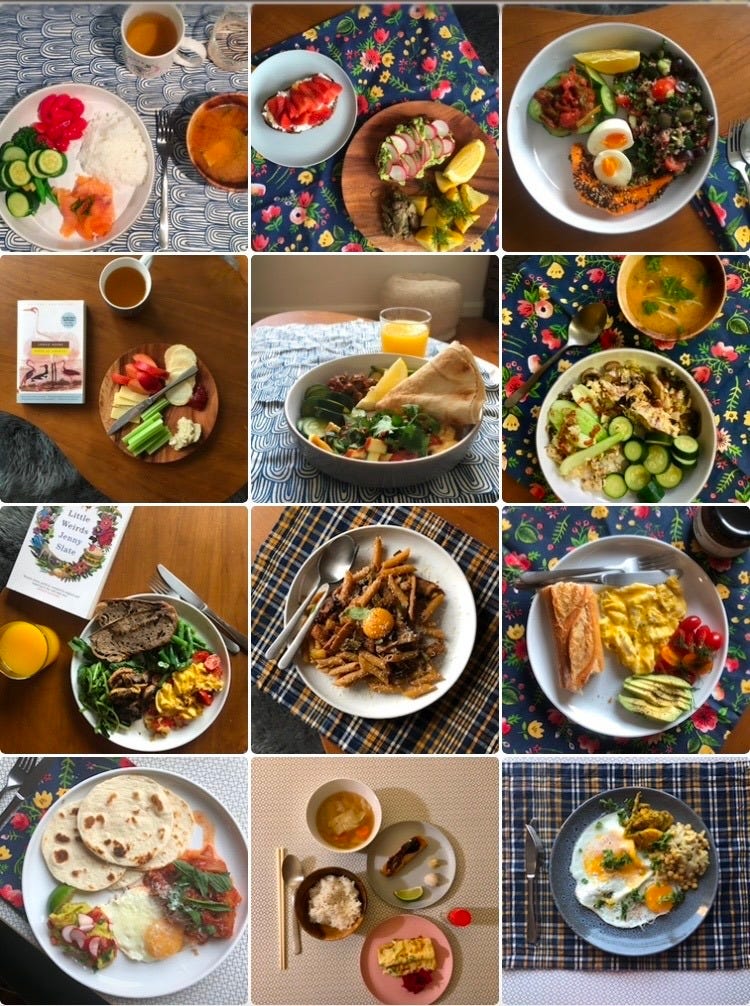
I used the thick, floral napkins I bought on my travels as placemats, instead of saving them for guests. I put away the IKEA family dining set and ate with mismatched plates or crockery which I’d found in thrift stores, and whose origin stories in my home no one else knew — like the wide, flat bowl I regularly served my dinner in that was once intended to be a fruit bowl.
The simple act of setting a place for one reminded me of a ritual I grew up with. When dinner was ready, Mum or Dad would ask my sister and me to ‘開枱’, a Cantonese term that translates directly to ‘opening the table’, meaning to get ready to eat.
I realized part of the loneliness of solitary dining was our exile from familiar rituals, and the sense of occasion that came from them. I saw Jones’s place-setting as a way to gently lay claim to that pleasure; her refusal to give up a simple, quotidian formality felt like a kind of anti-etiquette in a world where single people are expected to live with stoic efficiency. Who’s to say we shouldn’t enjoy the same anticipation created by a well-plated dish, served with care and flourish?
Of course, Jones knew more than anyone that throwing a good party meant taking the chance that things can, and will, often go wrong. Importantly, dinnertime alone need not be a thing of uncompromising joy or manic enthusiasm. I learnt that it’s fine to have nights when I show up to the kitchen feeling fed up and prickly, not in the mood to eat well or play host; or that I can enjoy dining on my own and still crave having someone to cook for from time to time. As Jones wrote, “Of course, we want to share with others, too, but we don’t always have family and friends round. And I can’t see taking in my neighbours every night.” For in the end, a fine solitary meal is also about sitting well with the longings which pleasure inevitably brings.
Since then, I have served dozens of meals for one, first at the kidney-shaped coffee table in that small studio, and in the subsequent homes that have followed. I make tacos for one and elaborate late breakfasts, I fry an extra egg on whatever I was eating if I need extra comfort, just like my mum would for us if she saw that we were glum. I take photos of the photo-worthy dishes. Not to share online, but as a private reminder that I have been cared for and fed well.
I once read that in Ancient Egypt, there was a ritual called ‘The Year of Eating’, in which the new bride and groom tested their compatibility not just in the bedroom, but in the way they ate together at the dinner table, after which they either stayed together or parted ways. I love the idea that companionable dining isn’t a given, but a lifetime’s experiment — and one need not have a partner to participate. When I set a table for myself, I feel part of the quiet celebration of the ebb and flow of life: the ever-shifting tides of being the carer to the cared for, guest to host, the loving to the beloved.
Candice Chung is an author and a Creative Writing lecturer at the University of Glasgow. Her work has appeared in The Guardian, BBC Radio, The Scotsman, The Sydney Morning Herald, Good Food and more. Her debut memoir CHINESE PARENTS DON’T SAY I LOVE YOU is named a LoveReading Best Book of 2025 and a Financial Times Best Summer Book of 2025.
Editor’s note: If you liked this piece, you’ll love the forthcoming The Spinster Cookbook: Culture, Politics and Pleasure in the Single Woman’s Kitchen by Eli Davies. It’s a beautiful and informative ode to the challenges of navigating a society built for nuclear families as a single woman, and we absolutely loved reading it — now available for pre-order from the Indigo Press.
*furiously looking up why she doesn't know that Judith Jones wrote a book on solo cooking*
Absolutely devoured this essay. I often cook, dine, and eat alone. I am plating breakfasts on a plate I bought 15 years ago because who needs 16-piece paraphernalia when you can enjoy a decadent sandwich all by yourself knowing how many hours of condiment research went between those slices. So glad I came across this essay!
This is a really cool piece, and I've been meaning to read the Judith Jones book for a while, so a great reminder. The book you announced, The spinster cookbook sounds fascinating too.