

Editor’s note: Today’s CELEBRATE piece is an interview with Alexandra Khripko and Canelle Mengual of Project Coven, a platform and wine community dedicated to amplifying women-made natural wine.
Alex and I go way back — she was the first person I spoke to at the initiation day of our Master’s program in 2015 — and it’s been beyond exciting to see what she and Canelle are creating with Project Coven, which officially launched late last year. They highlight women-made wines through shared storytelling on Instagram, host small tasting gatherings, often in collaboration with wine shops and restaurants led by underrepresented groups, and eventually, hope to maintain a living database of women winemakers to make discovery easier and more accessible. The ultimate goal is to create an inclusive, curiosity-driven space where conversations around wine, feminism, and regenerative food systems can unfold, and to build visibility and community around the women driving the natural wine industry forward.
Today’s interview traces their personal journeys into low-intervention winemaking, the founding of Project Coven, and the motivation behind their mission to amplify women in a traditionally male-dominated industry. It also dives into the possibility for natural wine to be not just a product but a cultural and political practice which embodies queer, feminist, and agroecological values. We hope you enjoy it!
-Isabela
Reply acronyms: AK (Alex Khripko); CM (Canelle Mengual); PC (singular response by Project Coven)
Isabela: I’m so excited to have you both here to chat about your new project! Before we get into it, can you tell me a bit about your personal and professional backgrounds?
AK: I was born in Tashkent, Uzbekistan, and immigrated to Toronto at the age of five.
After completing my Bachelor’s of Public Affairs in Ottawa, I moved to Berlin for my Master’s of Public Policy at the Hertie School, focusing on gender diplomacy and international relations. I then began working in the climate and energy sector after graduating, primarily with startups and cross-sector innovation initiatives globally at the German Energy Agency (where I met and worked with Canelle on the same team!)
Over an almost-ten year career, I grew increasingly frustrated about how often equity, diversity, and justice were overlooked in a sector preaching a better future. In some ways, I felt like we were losing the plot. We’re seeing in real time that climate innovation doesn’t automatically translate into universal prosperity, and I wanted my work to reflect that reality.
After leaving my climate tech job last year, I decided to channel my energy into addressing this through Bloom Climate Studio, as an independent consultant helping organisations design more grounded, effective & inclusive climate innovation programmes.
In between this career pivot, I was lucky enough to spend a couple of weeks doing wine harvests at two different women-owned (Glow Glow, Soma Vines), low-intervention vineyards in western Germany (grape picking, pressing, preparing for fermentation, bottling,etc). This solidified my already-growing desire to start a project amplifying women making and working in natural wine, having already completed my first level of WSET (Wine & Spirits Trust), and doing a Climate Farm School course focused on regenerative practices in 2023.
CM: I grew up in a rural area just outside Paris, close to the Champagne region and its vineyards. As a child, I spent most of my time outdoors, surrounded by animals. That early intimacy with nature stayed with me, even as I moved through cities and institutions. I studied Applied Foreign Languages and International Business at Université Paris-Est Marne-la-Vallée, spent a year at Lehman College in New York City, and eventually earned a Master’s in Marketing and Strategy from Université Paris Dauphine – PSL.
As a teenager, I briefly bought into the consumerist and capitalistic dream, but soon realized it wasn’t fulfilling. I knew I needed something more: a way to have a positive impact on society. That thread runs through my career. I started in marketing and communications with organizations like Lemonaid & ChariTea, then joined Alex at the German Energy Agency (dena) working on Start Up Energy Transition, connecting innovators pushing against the fossil fuel status quo. Today, as an Impact Manager at Phineo gAG, I support nonprofit organizations to increase their positive impact on society.
Over time and through the experiences, I noticed a gap in the mainstream sustainability and feminist movements: a lack of intersectionality. I began to see how systems of oppression are interconnected and realized I needed to connect the dots to rethink them. This perspective led me to co-found Reclaim, a Berlin-based ecofeminist organization working at the intersection of gender justice and climate protection. For five years, we’ve organized an annual one-day event where people can come together, create, and engage.
Now, I’m taking that same spirit of connection and regeneration into a new chapter: co-founding a natural wine project in Berlin with Alex! It feels like a return to my roots — bringing together people, nature, and community in a way that honours the land and the people who work it.
Isabela: What first attracted you to the world of natural wine?
AK: I generally got into wine in my early-mid 20s due to my dad, who got into scouting out amphora wines from Georgia or finding the best subscription boxes available in Ontario. Every time I visited home, he’d be excited to share a wine he found with me and it was and still is one of our connection points.
Natural wine came into my life a little later, and my first experiences with it weren’t the greatest. I happened to stumble across the more extreme, funky expressions from the early days, when many European winemakers were just beginning to transition toward low-intervention methods. It was a period of heavy experimentation, and the results were, at times, decidedly strange. However, the (re)emergence of natural winemaking continued to develop exponentially over the last years, and after trying some really amazing, expressive natural wines, it was really hard to go back to drinking conventional wine.
During this time, I also went to a lot of natural wine tastings and began learning more and more about the stark (and shocking) differences between natural and conventional wine production. This realization also pushed my professional interests further into the regenerative, nature-based side of things within the wide climate realm.
Especially after taking part in wine harvests in western Germany, I really began to notice the community, the collective, which manifests itself around regenerative wine production. Whether it was winemakers lending a hand to their peers in the final sprint of their harvest, or the chefs coming in from the city to cook for the harvest team, it was really beautiful, really special.
So then, after talking about doing something in this space for what felt like years (to the likely annoyance of my friends), we started Project Coven.
CM: Growing up, wine was always on the table, first conventional, then organic. My parents instilled in me a deep sense of responsibility regarding what I consume. We were the “organic freak” family, though back then, it was not about natural wine.
Ten years ago, when I moved to Germany, I discovered the white wines of the Rheingau, where my partner’s family lives. Walking through those vineyards and working the harvest gave me a profound appreciation for the work behind the fruit. It was then that I began to dive deeper into winemaking, fascinated by the process and life and stories of the makers. That’s when I started drinking natural wine and fell in love with it.
The taste reminded me of the Cidre Brut from my childhood in Brittany. But what resonated even more was the mindset behind it: it is all about the collective. This is why I’m bothered when natural wine is only seen as a hype or a luxury for superficial drinkers. It’s the opposite. Natural wine is a return to the roots of how we made wine before the industrial era. It is about simplicity.
In French regions like the Ardèche, natural wine isn’t a trendy label or a luxury item. There, you see small-scale farmers, often women leading the way, who reject the industrial, extractive model that treats land, animals and people as resources to be exploited. Instead, they practice a form of agriculture that is deeply relational: listening to the soil, working with the seasons, and valuing community over profit.
As an ecofeminist, this is the ultimate alignment. It’s a rejection of a system that seeks to dominate nature and a choice to live in partnership with it — to honour it.
Isabela: The conventional wine world is heavily male-dominated. What is the state of women and LGBTQ2+ representation in natural wine? How has this evolved over the years?
PC: The conventional wine world has long been male-dominated, and natural wine isn’t entirely exempt from that reality, but based on our conversations and initial research, there does seem to be a meaningfully higher presence of women in the natural wine space compared to conventional. That said, they’re still the minority, and there’s a pattern worth noting: women are often not the front face of the brand, with many occupying admin or back-office roles rather than being positioned as the winemaker or figurehead.
That’s slowly changing, though. There’s a growing number of initiatives dedicated to highlighting and celebrating women in natural wine, with books like We Don’t Want Any Crap in Our Wine by Camilla Gjerde and professional collectives like the Female Wine Collective in Austria helping bring more collective organisation and visibility to the women who are shaping this world. It feels like the natural wine community, with its generally more progressive ethos, is at least more open to that conversation than the conventional side.
As for LGBTQ2+ representation, it’s honestly something we’re still exploring ourselves. It doesn’t yet seem to be as prominent a public conversation within natural wine, but there’s definitely a real subculture there and it’s something we’re excited to help support.
Isabela: You recently co-launched Project Coven, a collective to champion women winemakers. What motivated you to get this going, and what are you hoping to achieve?
PC: Project Coven came from recognizing a gap that felt impossible to ignore mixed with a thought of “where can we best put our skills to work here?”. There are women making incredible natural wines, but they’re often not the ones being talked about, featured, or discovered. We wanted to change that by creating a dedicated platform and community to amplify women-made natural wine.
In practice, that looks like shared storytelling on Instagram, small tasting gatherings hosted in collaboration with wine shops and restaurants led by underrepresented voices, and longer term, building out a living database of women winemakers to make discovery easier and more accessible. But beyond the practical, we’re also trying to create a genuinely inclusive, curiosity-driven space where conversations around wine, feminism, and regenerative food systems can happen openly and inspire something bigger. We like to say that the natural wine part is sometimes a ‘gateway’ to getting people more interested in regeneration.
Isabela: How does intersectionality factor into your work?
PC: Intersectionality is central to how we think about this work. Supporting women in natural wine means nothing if it only centers one kind of woman. We’re already building that into how we operate, whether that’s who we collaborate with, who we choose to feature, or how we design our events. We’re also committed to learning from and working alongside BIPOC and queer collectives already doing this work, to understand where Project Coven can genuinely add support as the platform grows.
For example, Lauren Johnson-Wünsche, a wine and food writer here in Berlin runs a 300+ member Black Berlin Women Wine Group. That kind of community building is exactly the spirit we want to be in mutual support with.
Isabela: Let’s talk a little bit about the synergies between natural wine and agroecology. How does natural wine production differ from conventional production in terms of climate and environmental impacts?
PC: The synergies are deep, and honestly undersold in most conversations about natural wine. At its core, natural wine is simply how wine was made for most of its 8,000-year history. The mix included grapes, wild yeasts, minimal intervention, and a winemaker working patiently with their land. Back then, no lab yeasts, synthetic pesticides, or additives to correct color or texture were used. That also applies to the standardized flavor profiles we know today (meaning for example, with the right mix of additives, i.e lactic acid, you can make a French Chardonnay taste exactly like one you’d find in Napa Valley). With natural wine, the drink tasted like its home, and every year tasted a little different.
Of course, the 20th century changed all of that. Just like other commodities, as wine became a global product rather than a local tradition, industrial methods took over: synthetic pesticides and herbicides, cultured yeasts for uniform flavor, 49-plus additives in some conventional bottles, heavy filtration and stabilization to ensure consistency at scale.
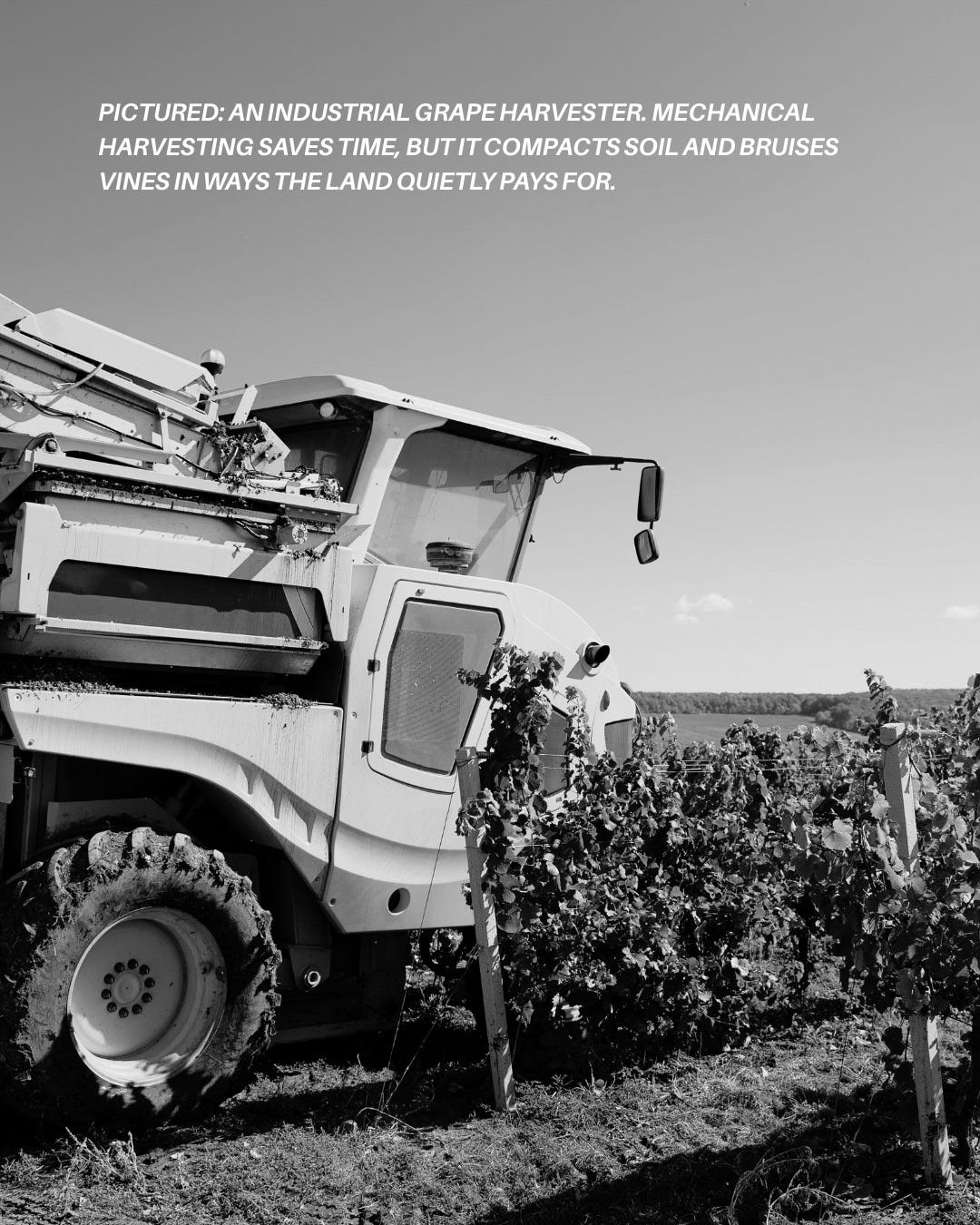
The goal shifted to efficiency, uniformity, and mass profit stability and in that process, wine became fundamentally disconnected from its land, its labour, and its ecology. Even the mechanical harvesting techniques used in traditional industry, though time-saving, compact soil and bruises vines in ways that quietly degrade the land over time (and take all the living beings living in the wines with it).
Natural wine, by contrast, is a return to something older and more ecologically honest. Land stewardship, biodiversity, transparency, and a relationship with the land rather than extraction from it. And we think that’s where the agroecology connection becomes so clear: both are rooted in the same principle that farming systems should work with natural processes, not override them.
Isabela: As you highlight, natural wine-making uses techniques that are very close to nature (no lab-made yeasts, no additives, etc). Yet — as we can both attest to, having lived in cities like Berlin and Barcelona — natural wine bars are often exclusive spaces that appeal to a certain global aesthetic and sensibility. How do you explain this contradiction?
PC: Ouf, it’s a real contradiction, and one we’re very much aware of and honestly concerned about. The principles underpinning natural wine are fundamentally anti-capitalist: working with the land, rejecting industrial systems, preserving traditions that prioritize ecology over profit. At its core, natural wine is for the people. It has always been.
But then obviously the market responded to the opportunity rather than the ethos, and that’s where things got complicated. The spaces natural wine became associated with were often designed to differentiate, to carve out a niche that was neither old money Veuve Clicquot on the Ku’damm nor your local dive bar, but something else entirely. And in doing so, they created their own kind of exclusivity. There’s a whole aesthetic that developed around it which we all know and probably succumb to as well… the orange wine, the olives in metal industrial bowls, the sourdough and butter, the Instagram-ready corner table. Ironically, a lot of these spaces that were trying to stand out ended up looking exactly the same.
At the same time, as with other fairly produced products, there’s also a real and legitimate tension around price. If you’ve ever worked a natural wine harvest, you understand pretty quickly why a bottle can’t honestly cost three euros. That kind of pricing only works if you’re squeezing the land, the workers, and the soil itself. Regenerative, low-intervention farming is labor-intensive, lower-yield and higher-risk by design. So some of the cost is real and justified. But that doesn’t mean the cultural gatekeeping or hip aesthetics around it are.
What gives us hope is that this isn’t the universal story. In parts of France, for example, natural wine isn’t a statement, it’s just what’s on the menu next to the beer, in unpretentious countryside bars and neighborhood spots in Paris where it’s simply normalized rather than sensationalized. That’s what we want it to be everywhere, because only then, with mass public acceptance, does the natural wine industry move out of its somewhat niche and pretentious status. Just to hammer home: the aesthetic capture of natural wine is a market phenomenon, not an inherent truth about what it is or who it’s for.
Isabela: I like that, because at the same time, we do see that many natural wine bars are proudly queer or women/femme-owned. How does natural wine embody feminist and queer values?
PC: In more ways than we could ever fully list. To start with the uncomfortable truth: women, LGBTQ+ and BIPOC people still face very real sexism, racism, and homophobia across the entire wine chain, from the vineyard to the bar. And while many conventional wine spaces do try to source interesting, quality-driven wines, the ethical rootedness that is quietly expected of natural wine production doesn’t tend to travel with them. That’s not to say every natural winemaker, distributor, or bar is actively embodying these values. But there’s an underlying current there, an expectation of integrity that perhaps creates a sense of safety and belonging for historically underrepresented groups.
There’s also something deeper at play. Natural wine, at its core, is a movement of resistance to mass industrialisation and ecological destruction. And it feels entirely coherent that a movement pushing back against the capitalist, largely male-led, over-extraction of land would find common ground with communities who have long been resisting the same structures of dominance and extraction. The oppressors, if you want to put it plainly, tend to overlap.
That’s actually part of why we named this Project Coven. The history of witches and witchcraft is really a history of the persecution of women, queer people, healers, and anyone who fell outside the white male colonialist status quo. People who had deep relationships with land, with plants, with community knowledge, and were punished for it in various ways. That lineage felt very relevant to us.
Isabela: Any winemakers whose work you particularly want to highlight?
PC: Our first interview series we did was with Šárka Betke, founder of Vinofactum, a distributor of Eastern European wines in Berlin. As of the last two years, she is also a winemaker herself, making wine in the village of Kobylí in the Czech Republic under The Lacery. She originally comes from a winemaking family in this village, making the choice to work with her native land a natural way to honor her roots. Though she took quite the indirect route to get there, with a career in tech across Europe and Asia, before pivoting to the wine world in Berlin and eventually finding her way back to the soil she grew up around. As she explained in one of our interviews, she founded Vinofactum to put Eastern European natural wines back on the global map and dismantle the misguided assumption that Eastern European = low quality.
Then there’s the incredible Maryam Hariri of Azizam Wines, who, after a global career in climate policy, decided to make natural wine in Baja, Mexico. She launched Azizam, meaning “darling” in Farsi, in 2022, focusing her work on climate-adaptive, uniquely Mexican varietals, sourced from old vines and small-scale sustainable farms. She’s actively working to challenge and decolonize the conventional perception of a winemaker, investing in the next generation of women in the industry. To us, she’s as much a talented winemaker as she is an advocate and a strong proof of concept for diverse leadership, dry farming, and resilience in viticulture.
We also love Jule Eichblatt, co-founder of Kommune 3000 and the entrepreneurial force behind Weingut Schätzel, a 650-year-old natural wine estate in Rheinhessen. Jule grew up on a crop farm in northern Germany and came to the estate originally for harvest in 2020, where she met winemaker Kai Schätzel. They’ve transformed the estate into a future-facing agricultural experiment, planting thousands of trees between the vines, grazing sheep for biodiversity, and producing naturally stable, unfiltered Rieslings. Kommune 3000, which Jule leads, brings young people from across Europe to live and work on the estate, supporting them in farming and personal development alike.
Isabela: What Project Coven initiatives should we keep an eye out for next?
We’ll be coming out with more winemaker and wine professional spotlights and interviews in the coming months, and hope to host our third event sometime in the Berlin summer. We’re also chatting with other collectives in the background regarding some exciting collabs. Follow us on Instagram at projectcoven.wine
If you’re keen to collaborate with us, we’d love to hear from you. Send us a mail to alex@bloom-climatestudio.com or reach out via Instagram.
